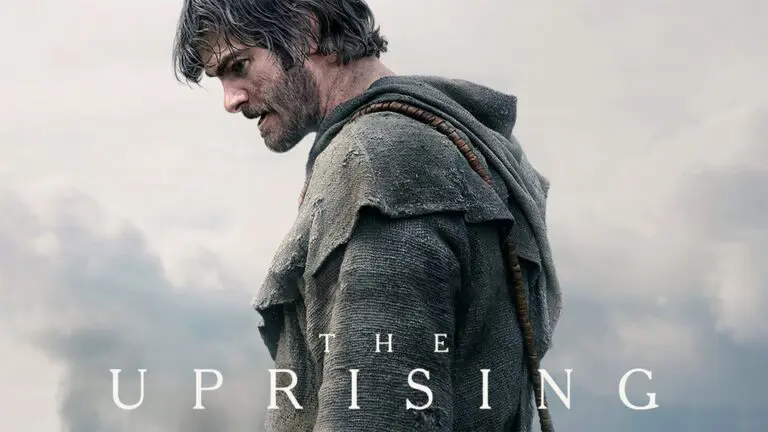

Historical characters can present a particular challenge for actors, and for the cast of The Uprising, director Paul Greengrass’ new film about the Peasants’ Revolt of 1381, the actors connected to their characters through themes of loss, power and betrayal when the world they’ve come to know and rely on begins to fall apart.
Two-time Oscar-nominated actor Andrew Garfield plays the nameless Ploughman, a farmer who lost almost everything, including his family, in the plague sweeping across Europe. As he becomes the de facto leader of the revolt, he is joined by Alyce (Thomasin McKenzie), whose own experience of betrayal fuels her rage.
On the other side of the uprising is King Richard II (Woody Norman), a teenage monarch burdened with immense power before he has developed the emotional maturity to understand it. Katherine Waterston plays the Countess, Richard’s mother, who, despite her extraordinary status, has limited freedom within a patriarchal court.
At a press conference attended by Casting Networks, the actors, along with Greengrass, discussed finding their way into their characters, from the wounds that shaped them to the different ways they experienced and wielded control over their lives, or the lives of others.
Key Insights
- Andrew Garfield built the Ploughman from his grief and near-total loss of identity, using the character’s ability to listen and observe as the foundation for his transformation into a reluctant leader.
- Thomasin McKenzie and Katherine Waterston found power in very different places, with Alyce driven by betrayal and rage while the Countess exerts influence through restraint, observation and silence.
- Woody Norman approached Richard II by looking beyond his cruelty to the vulnerable teenager underneath, showing how immense power, manipulation and emotional immaturity shaped the young king.

Andrew Garfield: Start With What Is Left
Garfield approached the role of Ploughman not through the person he became by the end of the film, but the broken man we meet at the beginning. A composite figure representing thousands of nameless, lower-class working people, Ploughman is pushed to the breaking point by crushing government taxes and tyranny, compounded by profound personal loss.
“It’s a beautiful character that Paul wrote that I had the honor of trying to inhabit,” Garfield said. “Where we meet him at the beginning of our story … there’s hardly any of him left … He has this thin crust of identity that he is clinging to tooth and nail. Through the process of the journey he goes on, that final little bit of crust gets fully cracked.”
Garfield described Ploughman as “more spirit than body,” but his strength also comes from his ability to observe and listen.
“He’s this reluctant leader and a kind of natural leader because he does have such little identity … he can actually pay attention,” observed the actor. “He can hear. He has the humility to maybe hear the wind … to feel who most needs a miracle, to really feel into other people’s pain and his own. There’s something kind of beautifully transforming in accepting that pain and letting an old self die with that pain, so something new can emerge by the end of our story.”
Garfield saw his character’s turning point come when the Ploughman decides survival is no longer enough. “It’s so fascinating. It’s like what happens to a person when they are squeezed to the point of saying to themselves, ‘Either everything changes, or today is a good day to die.’”
“It’s a hero’s journey,” added Greengrass.
Thomasin McKenzie: Let the Character’s Wound Drive the Character
McKenzie’s Alyce arrives at her own uprising through a different emotional route. Her history involves having been part of the church, taken advantage of, then cast away by those who were supposed to protect her. Invented for the screen by Greengrass, the character represents the women of the movement.
“Her uprising is a result of that betrayal, and just deep rage and brokenness” said McKenzie. “Throughout the entire film, from the beginning until the end, she’s driven by a very strong force to seek revenge.”
The actress pointed to a real connection between Ploughman and Alyce, which unites them in their common cause. “They see each other, and they both have suffered great grief and are processing that grief in different ways.”
As Alyce channels her past trauma into the rebellion, the actress herself noticed some parallels between what Alyce experienced during the 1300s and what women around the world are still experiencing today. “I definitely felt when we were filming that although Alyce had rage and purpose being a woman, she was still on the outskirts somewhat,” McKenzie observed. “There was a lot of watching and observing and inner turmoil. And that was what it may have felt like to be a woman then and what it feels like to be a woman now.”
Katherine Waterston: Finding Power in Silence
Playing a real historical figure comes with its own challenges, particularly when the history books offer few clues about who that person was beyond the role they played. For Waterston, the limited record surrounding the Countess of Salisbury left room to imagine the woman who was once supposed to be Queen.
“Sometimes today, in an effort to give women more to do in historical stories, we give them a reality that was not theirs,” said Waterston. “I felt I had a lot of room to imagine what she might be and not as much pressure to try to do something accurate, because there’s so much mystery around what she was.”
As the mother of the young King Richard II, the Countess occupies a complicated position. She has proximity to enormous power, but as a woman in that world, she cannot wield it directly.
“It was one of the great treats of the character that she’s there and unable to speak, and what that communicates, and what it accurately portrays about the period,” the actress said. “I loved her silence in this film and what I was allowed to then explore within that. And how sophisticated she had to be to try to influence in a situation where the verbal wasn’t always available to her.”
As the Countess, Waterston had to portray a woman who would have been Queen had her husband not died young, but was now forced to defer to her teenage son who inherited the throne and was mentally not prepared to rule. Unable to advise Richard openly, the Countess uses subtler means to guide him while navigating a self-serving council with its own agenda.
Waterston’s phrase during production, she joked, was “Queen and not heard,” a play on the traditional proverb “children should be seen and not heard,” which carries the expectation that children, and historically women, should remain quiet and well-behaved. It was an acting exercise she found fascinating to take on.
“I feel like it’s an underrated thing to not have much to say in a film,” she said. “It’s a visual medium, and there’s so much you can do.”
Woody Norman: Humanize the Character You Hate
Norman faced perhaps the most complicated challenge of the four performers: playing a character who becomes monstrous while finding a human being underneath him.
Richard II was only 14 years old during the Peasants’ Revolt, having become King at the age of 10. For Norman, who turned 17 earlier this year, playing someone so young while wielding such enormous authority was his entry point into the character.
“As someone who is going through my [own] teenage years, I feel that need for finding my own power in my life,” Norman said. “And dealing with my own ego.”
Richard’s circumstances were extreme, and Norman described him as “incredibly mentally ill,” while simultaneously navigating the immense responsibility of being King of England. “At the time, the King was second to God,” said Norman. “And he believed that.”
Norman also saw Richard as someone who was being used, manipulated and abused by corrupt aristocratic advisors, further complicating his relationship to control.
“I tried my best to humanize him,” he said. “But he was such a bad and evil person that it was hard to do that. Even when I was playing him. I hate him.”
Greengrass noticed vulnerability in Norman’s performance, particularly in the circumstances of a child who had been told from an early age that he was essentially divine.
“You felt this boy who’d been brought in as a child and told, ‘You are the Messiah,’” Greengrass said. “Literally, that’s what they said to him. He was brought up to be the Messiah. I mean, what does that do to your head?”
Greengrass ultimately pointed to the themes of power as the thread connecting all four characters. The Countess has wealth, privilege, land and proximity to the throne, but as a woman in her world, she does not have a voice. Alyce has rage and purpose, but little conventional standing. The Ploughman appears to have almost nothing, yet possesses an inner strength that cannot be taken from him, and ultimately becomes the uprising’s reluctant leader. Richard has almost unlimited formal power, but lacks the age and emotional maturity to handle it.
“This is a film that’s about power in many ways,” the director said. “It’s what kind of power do you have and what kind of power don’t you have? All of these people are navigating worlds in which they have some power, but not complete power.
For the cast of The Uprising, stepping into the past meant looking beyond titles, historical events and familiar ideas about power to find the human beings underneath. Whether working from grief, betrayal, silence or the overwhelming burden of authority, each actor found a different way into a character navigating how much control they had over their own life.
Their approaches also offer a useful reminder for actors taking on historical roles: the circumstances may belong to another century, but finding the character often begins with something timeless, whether it’s loss, anger, fear, ambition or the need to be heard.