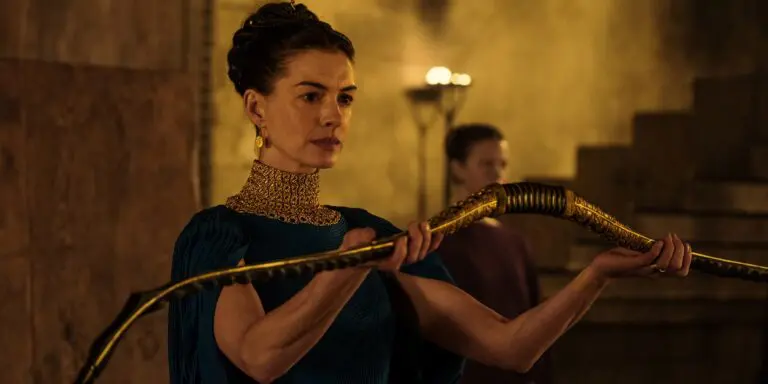

In Christopher Nolan’s cinematic adaptation of The Odyssey, Anne Hathaway plays Penelope, the legendary queen of Ithaca who holds her kingdom together while waiting for her husband, Odysseus (Matt Damon), to return.
At a press conference attended by Casting Networks, Hathaway shared the technical adjustments and acting choices needed to bring the iconic character to life in a film shot entirely with IMAX cameras.
Key Insights
- Anne Hathaway adjusted her performance for IMAX cameras, using emotional restraint and subtle expressions to convey Penelope’s inner turmoil.
- Studying ancient Greek words and exploring Penelope’s motivations helped Hathaway develop a character whose patience and composure served as forms of protection.
- Costume colors, hair design and physical presentation became essential tools for expressing Penelope’s strength, status and enduring hope.
How Anne Hathaway Adjusted Her Acting for IMAX Cameras
Hathaway previously collaborated with Nolan on The Dark Knight Rises and Interstellar, but bringing intimate drama to IMAX presented a new technical challenge. On a massive IMAX screen, close-ups can reveal even the smallest facial movements, making Hathaway particularly conscious of how much emotion she expressed physically.
“I was flying blind because the only acting I’ve ever done for an IMAX camera has been a lot of action sequences,” Hathaway explained, adding that combat work involves far less awareness of acting directly for the camera. The intimacy of The Odyssey, therefore, demanded an entirely different approach.
“Of course I relied on Chris, but the truth of the matter is, we were all beginners,” she said of applying large-format cameras to intimate character work. “Chris had never shot an intimate scene on IMAX before. Matt had never done it. Everybody from the most experienced, powerful person on the set to the newest member of the team, we were all on the same page. We were all having a beginner experience.”
That unfamiliarity encouraged Hathaway to reconsider instincts that might read differently on an oversized screen.
“I just wanted to be a bit controlled in certain scenes … so like I said, I relied on Chris to guide my performance,” she continued. “But I was definitely aware of not wanting to do too much, because I thought that could be fatal on a camera like this, on lenses like these.”
She carried that restraint into emotionally charged scenes, resisting the impulse to push feelings outward because of what the camera would capture.
“In the scene with Telemachus [Tom Holland], I had this vision in my head that she had a mask of rage,” Hathaway noted. “I was aware of that feeling and not wanting to do too much with the anger because there was going to be so much force coming out.”
For actors working on camera, Hathaway’s experience illustrates how performance choices can change depending on framing and format. Learn more about acting for dramatic close-ups.
How Ancient Greek Words Helped Hathaway Develop Penelope
To anchor her performance, Hathaway studied ancient Greek translations to find individual words she could use as internal emotional triggers on set.
“It was full of amazing Greek words inside of it,” she said.
Terms like archegos (leader) and kakia (evil) became examples of what Hathaway called “access words” that helped her find her way into Penelope.
“I remember standing [as Penelope] behind the screen and looking out at all the suitors and thinking kakia and stuff like that,” she said. “It just helps.”
Rather than relying solely on dialogue or outward expressions, Hathaway used these words to connect with Penelope’s internal experience, giving herself specific emotional references to draw on during scenes.
Finding Penelope’s Strength Through Patience and Emotional Restraint
In classical mythology, Penelope is characterized by long-suffering devotion and loyalty, qualities that can easily register as passive on screen. Hathaway reframed those virtues as tactical survival mechanisms.
In Homer’s epic, Odysseus is away from home for 20 years, leaving Penelope to fend off aggressive suitors vying for the throne while protecting her son, Telemachus.
Rather than playing Penelope as a passive observer waiting to be saved, Hathaway approached her as Odysseus’ equal in cunning, using her perceived modesty to protect herself and her court.
“I thought about masks, and I thought about the things that would allow her to live safely,” Hathaway said. “I thought about what her priorities were, what it would mean to be the queen of a kingdom where the king is absent, and what it would mean to be the mother of a son who was always in danger. I thought that her mask is a really important part of her armor, but that patience, that fidelity, while I’m sure being authentic, it’s also a weapon that she has.”
By the time the story reaches its climax, that restraint reaches its limit.
“It was clear to me from the script that 20 years in, she was ready,” Hathaway added. “She was feeling a whole lot more than just those things the entire time.”
That tactical view also freed her from feeling the need to soften her character’s presence for others in the room.
“I felt no apology in her,” Hathaway stated. “When Antinous [Robert Pattinson], for example, comes into her chamber, she doesn’t attempt to please him or charm him or be nice. She’s not imperious in the way she dismisses him, but she’s kind of like, ‘Oh, you can get out of here.’”
The actress said she enjoyed being at an age where she could play a character who is on her own journey, focused on how she feels and not trying to smooth the road for other people.
“Normally when I play characters like that, they’re the bad guy, but she’s not,” said Hathaway. “She’s just sitting in her power such as it is.”
How Costume and Hair Helped Hathaway Build Her Character
After initial wardrobe camera tests involving soft pinks, Nolan and costume designer Ellen Mirojnick shifted Penelope’s wardrobe to bold jewel tones.
“Chris wants you in color, like really, really strong color,” Hathaway recalled being told.
Hathaway found the character motivation behind the palette while wearing an orchid gown, realizing that the wardrobe tied directly to her absent husband.
“She wears color,” Hathaway said, “because she’s not in mourning because he’s not dead. And she gets dressed up and does her hair every single day, because today could be the day that he’s coming home.”
The structured hairstyling completed that regal armor.
“There’s something architectural about it,” Hathaway added of Penelope’s hair design. “There’s something sculptural about it. Because I had nothing much on my face other than the aging makeup, the silhouette of the hair was going to add so much of what made her regal.”
What Actors Can Learn From Anne Hathaway’s Performance in ‘The Odyssey’
Hathaway’s approach to Penelope demonstrates how character development extends beyond memorizing dialogue and expressing emotion. From adjusting her performance for IMAX cameras to finding meaning in ancient Greek words, costume choices and subtle physical restraint, she built a character whose inner life informs every outward decision. For actors, her experience offers a reminder that understanding a character’s motivations, collaborating with the director and making intentional performance choices can be just as powerful as the emotions themselves.