
David Kirschner has spent more than four decades creating some of pop culture’s most recognizable characters, from the Sanderson sisters in Hocus Pocus to Chucky, Fievel and Curious George. But when it comes to what makes a character unforgettable, he doesn’t have a formula.
What he does have is a deep appreciation for actors who bring something to a role that wasn’t on the page. Whether it’s Kathy Najimy barking and sniffing out children in Hocus Pocus or Jennifer Tilly improvising dialogue in Bride of Chucky, those unexpected choices are often what make a performance stick.
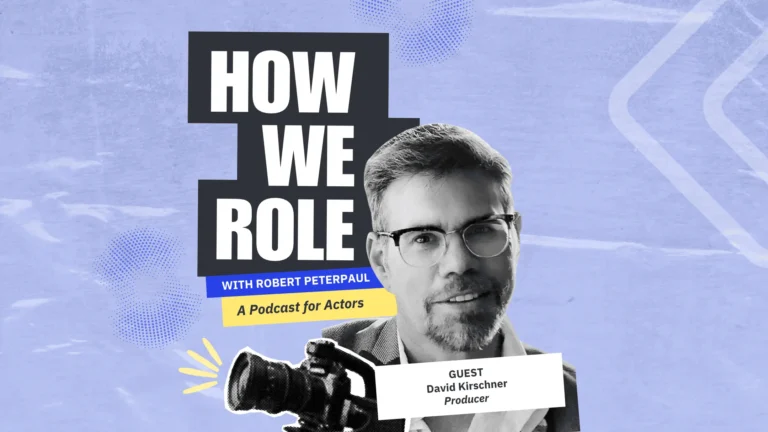
Kirschner joined host Robert Peterpaul on How We Role to talk about the auditions that give him goosebumps, why kindness matters when choosing collaborators, and what actors can learn from the characters he’s helped bring to life.
In this episode, you’ll learn:
- Why the best acting choices often aren’t written in the script
- How physicality and small character details can make an audition stand out
- Why taking creative risks matters more than playing it safe
- What Steven Spielberg taught Kirschner about creative confidence
- Why memorable villains need humanity, not just menace
- What makes a producer want to hire an actor again
- How curiosity and preparation can help actors build lasting careers, plus much more!
Bring Something That Isn’t on the Page
Kirschner believes the best actors bring something to a character that no writer could fully anticipate.
He points to Hocus Pocus, where Bette Midler found genuine affection beneath Winifred Sanderson’s constant frustration with her sisters. Kathy Najimy, meanwhile, introduced physical choices that weren’t scripted, including sniffing out children and occasionally barking.
Jennifer Tilly took that creative freedom even further in Bride of Chucky, writing an entire exchange between Tiffany and Chucky that became one of the film’s biggest laughs.
For Kirschner, those moments are what separate a good performance from one audiences remember. Actors aren’t simply delivering what’s written. They’re adding another layer of humanity, humor or personality that makes the character their own.
Make an Audition Choice That Gives Casting Goosebumps
Kirschner has enormous respect for actors willing to walk into a room full of strangers and commit to a character. What gets his attention isn’t necessarily the biggest performance, but the most unexpected choice that still feels right for the role.
He encourages actors to experiment with distinctive voices, physical mannerisms and character details, while recognizing the fine line between making an interesting choice and overdoing it.
He’s particularly drawn to moments when an actor introduces something neither the writer nor director had imagined.
“And when I get goosebumps, that’s the sign that it’s really working for me,” he said.
His advice for actors competing against a roomful of people reading the same lines is to take a chance. Bring something personal to the interpretation instead of simply trying to deliver the scene as expected.
Find the Humanity in Every Character, Even the Villains
From Chucky to the Sanderson sisters, Kirschner has helped create plenty of characters who behave terribly. But the ones he finds most compelling have something more going on beneath the surface.
He points to Leonard Nimoy’s performance in The Halloween Tree, where a seemingly sinister character is ultimately moved by the compassion of the children confronting him.
“I love villains that have nuance to them, that there’s some depth to them,” he said.
That complexity can come from the smallest physical choice. Kirschner recalls watching Meryl Streep in The Bridges of Madison County subtly adjust herself while walking away from Clint Eastwood. To him, that nearly imperceptible movement revealed her character’s self-consciousness and desire to be attractive to someone she cared about.
For actors, the lesson is to look beyond the obvious emotion of a scene. A villain can feel love. A confident character can be insecure. Sometimes the smallest contradiction says the most.
Your Creative Process Doesn’t Have to Look Like Anyone Else’s
How far should an actor go to inhabit a character? Kirschner doesn’t believe there’s one right answer.
Discussing the different approaches of performers like Jeremy Strong and Brian Cox, he acknowledged that some actors need to live inside a role while others prefer to separate their work from their everyday lives. For Kirschner, those differences are part of what makes artists interesting. He compares individual creative processes to fingerprints: no two are exactly alike.
The same applies to finding inspiration. Kirschner builds his characters through personal memories, conversations and observations of everyday people. He knows actors who ride buses or spend time in airports simply to study how strangers behave.
Those details can become useful material when developing a character, whether it’s an unusual mannerism, a way of speaking or an emotional response.
Steven Spielberg’s Advice Changed His Confidence
Kirschner’s career began as an illustrator working with Jim Henson before his creation Rose Petal Place attracted the attention of Steven Spielberg.
When Kirschner eventually presented An American Tail, Spielberg got down on the floor with him to examine his sculptures and artwork. Rather than simply praising what he’d created, Spielberg expressed excitement about the ideas Kirschner had yet to develop.
Kirschner credits that encouragement with transforming his confidence as a young artist.
The worst creative note he ever received was considerably less helpful. While working on the animated series Gravedale High, someone wrote just two words on a page: “Do better.” The problem wasn’t criticism itself, but the absence of anything specific he could actually use.
For actors navigating feedback, it’s a reminder that meaningful direction should help clarify or strengthen a choice, rather than simply demand a better performance.
Talent Gets You Noticed. Kindness Gets You Invited Back.
When asked what makes him want to work with an actor again, Kirschner’s answer was straightforward: preparation, professionalism, kindness and, of course, the performance itself.
He cited Brad Dourif, the longtime voice of Chucky, as an example. Dourif is quiet and focused on the work, but his performance consistently captivates Kirschner.
He also praised voice actor Frank Welker, whose talent and warmth have made him a repeat collaborator across multiple projects. Kirschner values those relationships enough that he sometimes wants to develop new projects simply to work with certain people again.
That doesn’t mean actors need to have outgoing personalities. What matters is showing up prepared, treating people well and bringing something compelling to the work.
Stay Curious, and Do the Work
Kirschner’s curiosity has remained a constant throughout his career. He visits museums, explores different art forms and talks to people from all walks of life, collecting observations that eventually find their way into his characters.
He also recognizes that the entertainment industry is changing, particularly as artificial intelligence affects opportunities in areas like voice acting.
His response is to keep learning, researching and doing the work necessary to compete. “If it’s not you, it’s gonna be somebody else,” he said.
It’s a phrase he’s repeated to himself since his teenage years, when he was trying to enter the industry without connections or financial advantages.
For actors, his message is less about waiting for the right opportunity and more about preparing to make the most of it when it arrives. Stay curious, make bold choices, treat people well and keep developing what makes your work uniquely yours.
Listen to How We Role on Apple Podcasts, Spotify, YouTube or listen to David Kirschner’s full episode here.
Ready to find your next role with Casting Networks? Sign up for a free trial today!