
How do I audition for commercials?
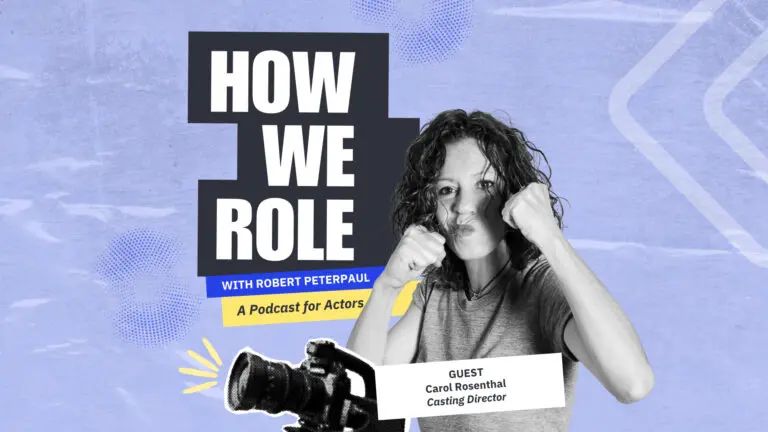
If you’re an actor pondering this question, this episode is a must-listen! Jumpstart your commercial career with commercial Casting Director Carol Rosenthal. The industry vet joins actor Robert Peterpaul for a transformative chat on how actors can break into commercials and start booking.
Rosenthal has spent over 25 years casting the faces you see (and the voices you hear) in commercials; but she didn’t start behind the scenes. In the early ’90s, Carol was in front of the camera on a few sitcoms. From there, she worked her way through many corners of TV and film production before finding her true calling in commercial casting, where she’s been ever since.
We share practical ways to stay ready year-round, avoid common casting profile mistakes, and optimize your self-tapes for every commercial genre.
Key insights from this interview for actors:
- How to start getting commercial auditions
- How to get a commercial agent, if you need one
- Quick playbooks for Super Bowl, luxury, medical, food chain, and celebrity-led commercials
- Smart and subtle things casting loves to see in a headshot
- How to optimize your casting profile to make casting’s job easier
We want actors to get the job.
Listen to ‘How We Role’ on Apple Podcasts, Spotify, or anywhere you stream podcasts.
When commercial work comes in
Carol says commercial work no longer runs in neat seasons. Demand still climbs around the Super Bowl, the Oscars, summer travel and clothing spots, back-to-school, and the holidays, but content now lives online all year. Her advice is to stay ready. Keep a few comfortable outfits on hand in casual, upscale, and business looks so you can say yes when a call comes in. For quick turnarounds, see Tips for Turnarounds: Self Tapes on Short Notice.
First-round commercial auditions are fast reads, so there’s less room to build a character than there is in a theatrical audition. A callback is where you can show another color.
Headshots that match the person in the room
Carol says more submissions now arrive with headshots that don’t match the actor who walks into the audition. If a role calls for a beard, a bob, or a streak of color the actor no longer has, she can’t put them forward. Her ask is to update headshots about every six months rather than every two years, and to make sure agents keep profile photos current too, since the first image she sees is often the one that earns a look.
Keep your headshots really, really up to date.
For commercials, she prefers a natural-light smile in a t-shirt as the first image, with a more upscale option in a business jacket behind it. Understated works better than over the top. Subtle humor can land, too. She remembers an actor whose headshot hid a third wrist under his chin, and she was sold the moment she spotted it. Keep the joke out of the lead photo.
Submissions: be honest about skills and location
Carol casts with a huge volume of submissions. For one SAG T-Mobile job, she received 10,000 and still reviewed every one. That’s why she asks actors to skip roles that call for a specific skill they don’t truly have. When a role says the performer must be an experienced skateboarder, she still gets thousands of submissions from people who list general skateboarding. Keep special skills to what you can actually do, and make sure your location is accurate. A casting director can’t bring in someone who lives in another state the night before a shoot.
Submission notes should be brief and specific. Carol doesn’t need a list of recent credits. She wants the details the breakdown asks for, such as whether a child gets seasick on a boat or whether a child’s work permit is ready to go. Read the breakdown and answer its questions.
For more on building a commercial-ready profile, read Getting Started With Commercial Auditions.
Self-tapes: clean the lens and take your time
Carol opens her self-tape advice with an apology. She knows how exhausting it is to handle the setup, the lighting, and the performance with no one across from you to read the scene. She also has one request she says almost nobody makes.
Please clean your lenses.
A foggy or grimy lens makes a tape hard to watch, and she sometimes won’t send it forward. A plain wall or an open room works well as a backdrop, while a busy room with bookshelves and clutter pulls attention away from the actor. Carol also finds ring lights clinical when they show up in the eyes, so she wants to see the eyes. If you have to record in your car, say so in the slate. Otherwise it can read as last-minute and careless, and a short apology shows that you care.
Don’t rush your first line either. Give a beat before you start, even a few seconds of saying goodbye to someone or noticing something off camera. Carol can redirect an actor in the room, but she can’t do that immediately on a self-tape, so the tape has to show your range on its own.
For more self-tape advice from casting directors, see Master Your Self Tape: 14 Top Tips From Casting Directors.
Commercial types and what casting wants
Super Bowl and sports spots. Carol wants energy and abandon. If the spot calls for someone screaming at the television, let it rip. For team gear, keep it real and skip anything that looks overly styled, like sequins on a fan’s hat.
Luxury brands. Expect upscale, aspirational people, often more model than character. Dress upscale casual, leave the goofball side at home, and keep any quirk understated.
Medical and everyday spots. Carol describes medical ads as grounded and real, not high-end. Middle American means something broader today than it did in the 1980s, so you don’t have to fit a single type.
Food chains. These often call for Americana and very real people. Carol likes to bring in a range of types, from the family member to the person with a small piercing, unless the breakdown says otherwise. Fast reads are normal here.
Brand names. Say the brand clearly. Don’t mumble it, because that’s the word the spot needs heard. Whether to smile depends on the scene, since a forced smile can read as a hard sell.
Celebrity co-stars. Casting teams look for actors who stay comfortable around a celebrity. A tongue-tied read is hard to use when you’re acting next to someone famous.
Kids. Carol prefers natural children over coached ones. If a child is overdoing it, she would rather bring the energy down than push for a bigger performance.
Slates. Be yourself in the slate, and don’t start with a laugh you’ve saved for the audition. A grounded slate lets the casting team see range when you step into character.
Feedback, tone, and asking for help
When you don’t book, Carol says the best move is to ask for feedback. She remembers how stuck she felt after a Saturday Night Live test, when she didn’t take the casting director’s advice and didn’t get the role. Ask what you could have done differently, and take the advice you’re given seriously.
Casting directors are not gods. We just are a conduit, you know?
When a brief is vague on tone, Carol asks the agency producers for a short description of how the spot should feel, sound, and look. If the answer is still unclear, she reads that as the client not having decided yet, which gives the actor room to bring something of their own.
An agent helps a lot, but actors can submit through Casting Networks without one. If you’ve worked with casting directors, ask whether they’d suggest a few names or write an intro. Carol got her first agent through a friend who was a casting director. Don’t wait for someone to offer. Ask. For more on getting and keeping representation, hear how Michele Cavallero approaches it on How We Role.
Stay true to your colors
Carol’s closing advice is to trust your gut. Actors want the job so badly that they often try to mirror exactly what the casting team wants. Carol says teams are often looking for something they haven’t thought of yet. Keep your natural qualities, bring them into the room, and remember that the best commercial work comes from actors who are having fun.
Trust your gut that you have something special to bring to it.
Hear the full conversation with Carol Rosenthal on ‘How We Role,’ available on Apple Podcasts, Spotify, or anywhere you stream podcasts. Find more episodes on the How We Role podcast page.
This is How We Role. Discover fresh casting calls at castingnetworks.com.