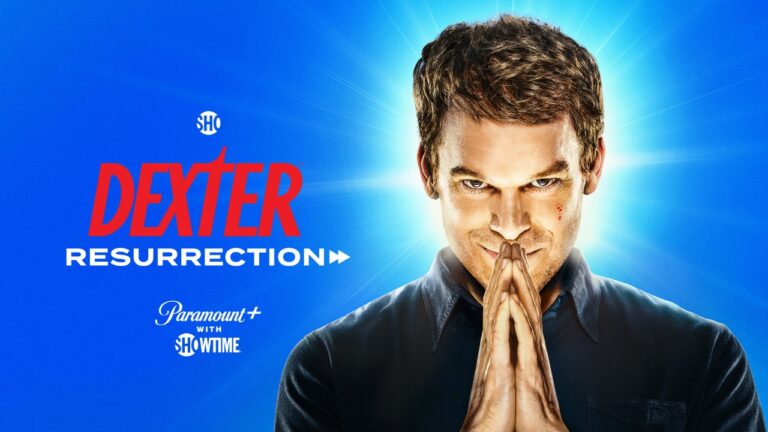

With deep roots in the Dexter franchise, casting directors Ross Meyerson and CJ Molidor brought both experience and familiarity to Dexter: Resurrection, the latest chapter in Showtime’s long-running hit series.
The latest series focuses once again on Michael C. Hall’s title character, now in New York City, as he navigates a whole new world of serial killers. Both seasons star Uma Thurman, James Remar, Jack Alcott, Ntare Guma Mbaho Mwine, Kadia Saraf and Peter Dinklage.
The casting directors are in the midst of their work on shooting season 2, which is currently in production. They talked to us from LA.
Key Insights
- Great casting isn’t always about finding the actor who matches the role on the page—it’s about finding the actor who reveals what the role can become.
- Small roles often carry enormous story weight, which is why casting directors approach one-scene characters with the same care as series regulars.
- Unexpected choices create memorable television, whether it’s casting a comedian as a serial killer or discovering a lesser-known actor who brings something nobody anticipated.

Are there certain advantages to coming onto a show that is already in full swing?
Ross Meyerson: I actually worked on the pilot. The show was going to shoot on the East Coast, and then it ended up not, so we left. Or it left us. Then we came back on New Blood, because CJ and I had worked with [showrunner] Clyde Phillips on a number of shows, so we had some familiarity with the background of the project.
I think it was really more about our relationship with Clyde and [EP] Scott Burke, coming into a project where we were already had worked with the producers, and that always makes things a lot easier, because you understand them, and they help you understand the fabric of the show.
CJ Molidor: That helps us so much, knowing them, but I also think, obviously, it’s high expectations. There’s a lot of fans that love this show that have their own theories and thoughts, and what they want, so there’s a lot of expectations to make sure we’re living up to what the fans want.
Do you find yourself checking online to see reactions?
CJM: Ross reads all the little theories. (Laughs)
RM: They all had theories, even this year, about who should be in it. They know what’s coming, they know the folklore of the show so it doesn’t sway us, but then it’s very hard not to chime in when something is written online and say, “Hey, that’s not the way it happened.” At one point, Tom Cruise was being bandied about, and then the whole fan world thinks Tom Cruise is going to be on the show. CJ, do you feel the pressure of thinking, “Are we got to live up to that?”
CJM: No, but it is very interesting to see what the people think, or all their expectations. It’s fun to see that side of it, and then also to see the reactions when they announce the people that we do cast.
What about the casting of established actors in those cameos, like Eric Stonestreet, Neil Patrick Harris and David Dastmalchian?
RM: I think we felt we could get people, and it’s at least partly about seeing people that you might not expect. When Clyde and Scott and [EP] Marcos Siega talked to us about Eric’s character, I can’t think of too many other times in my life where I called CJ up and I was like, “it’s Eric Stonestreet.” Every single person that we offered it to said yes.
Eric Stonestreet is not someone you think of as a serial killer. David Dastmalchian, however …
RM: Yes, that’s what made it such a great mix of characters, who to expect and who not to expect. That’s a challenge for this show. It’s not like we have to guess who the killers are. But I think it’s still fun for us to then have those characters appear, and people go, “Wow, did not see that coming.”
What about less familiar faces, like Ntare Guma Mbaho Mwine and Kadia Saraf?
RM: Here’s a crazy thing about Ntare — he was in the graduate acting class of my roommate, and I saw him at NYU, many, many, many, many years ago. When I read the role, I thought of Ntare, and he had been on another Showtime show, and then it was weird, [everything] started clicking because Showtime knew him, [EP] Scott Buck had worked with him, so that was just universes aligning of somebody who we all knew from different walks of life. CJ, had Kadia been on your radar at all?
CJM: Between Rescue Me and when we saw her, only through Instagram, but not really in anything else, I’d just met her before and known her, but no, not really.
RM: I can’t tell you how many people we read for that role. It was just an incredibly difficult role to find. You name an actor, we read them.
Why was it so hard?
RM: The fact that the character, I guess we could say is on the spectrum, and that’s a really hard thing to find, and was a really difficult thing for people to understand. Tell me if you agree with me, CJ, but I think Kadia was the first person who we saw where it was effortless for her. It didn’t feel she was playing at being on the spectrum, and I don’t even think we called her back.
CJM: No, she had it right away.
RM: She just understood. I don’t know if she knew somebody, or she had some sort of history that gave her the understanding of the character that just helped her, but again, it was just effortless for her.
What about the sense of satisfaction you get from finding someone lesser known who comes in and knocks it out of the park?
RM: One role that comes to mind is the guy in Ohio last year that Uma’s character goes to see [played by Max Von Essen]. That was a one-scene role, but it was with Uma Thurman, and that scene itself had an arc to it. Maybe it was one page to a page and a half, but it was an incredibly important scene, because it was establishing the story.
CJM: That established the whole club thing, the red envelope, the money, all of it.
RM: It’s roles that you don’t think [of], when you’re reading the script the first time, how important they are going to be to the story, how important that character is, and how important finding the right actor for that role is.
It goes to show how important bringing interesting ideas and big choices are to auditions, and how that can actually affect the final version of the character.
RM: Yes. Going back to Kadia, I don’t know that we knew what that role should be, and we didn’t know what it was until we saw it. That role probably defines that. It happens on certain shows, because sometimes we think we know what it is, and then we bring it in, and strangely, our producers go, “That’s great! We love that!” Sometimes, it’s by accident.
And that’s how some of the best alchemy happens.
CJM: Yeah, for sure.
Halfway through the second season, are there specific challenges this time around that you didn’t have the first season? Or is it easier?
RM: I don’t ever say anything’s easier, but because a lot of the characters were established from the year before, we set the table nicely, which I think makes this season a little easier. However, setting the table as nicely as I think we did, it also makes us have to live up to the challenge of living up to that season. In finding Dan and Brian, it was in the back of my head, “Let’s knock this out of the park again.”
Looking for TV auditions in your area?
Browse Television casting calls in: