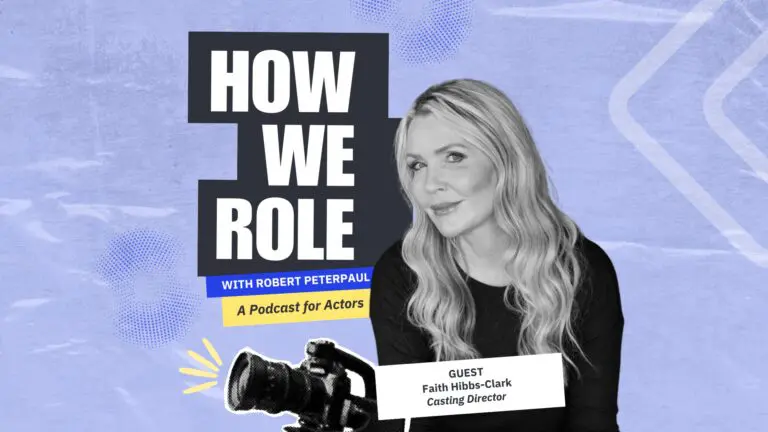

Faith Hibbs Clark became a casting director by accident.
She was publishing Drama Beat, a print newspaper for local theater actors, when a film producer called to place an ad looking for talent. The paper came out every two months. The producer needed actors now. So she offered to find them herself.
He told her there was “10 in the budget.” She assumed he meant $10. The check that showed up in the mail was for $10,000.
At the time, Hibbs Clark was also working as a deception detection expert, reading body language for CEOs, trial attorneys and eventually politicians. Nearly 30 years later, those two careers have merged into the Acting Science Method, a film and TV training approach built on communication science, psychology, neuroscience and human behavior.
Calling in from a medieval village in France, she joined host Robert Peterpaul on How We Role to explain why every performance is a lie, why your body speaks before your lines do, and how actors can use science to create believable work on demand.
In this episode, you’ll learn:
- Why acting is the only lie the audience agrees to
- Why the audition you nailed doesn’t book, and the rushed self-tape does
- The “reaction first” formula for delivering lines the way the brain actually works
- How body language coding can trigger real emotion
- Why leaning on audition nerves for a nervous character can backfire
- What too much eye contact actually signals
- How to train your brain to spot opportunities, plus much more!
All Acting Is a Lie, and That’s the Point
Hibbs Clark’s deception detection work comes down to one question: does someone’s body language match what they’re saying? When it does, it’s probably the truth. When it doesn’t, and three or more “tells” cluster together, it’s likely a lie.
Through her research, she identified 13 types of lies. One of them is the actor’s entire job.
“The entertainment lie is unique among the types of lies because it’s the only type of lie where the other party consents to being lied to,” she said. “But there’s one really important caveat that you need to know in order for people to suspend their disbelief. That lie has to be believable.”
Focus on What’s Perceived, Not What You Feel
Traditional methods ask actors to go inward. Hibbs Clark asks them to think about the receiver: the person watching.
“It’s not about what you’re feeling as much as it’s about what’s being perceived,” she said.
That’s why an audition that felt perfect doesn’t always book, while a self-tape shot between Disneyland rides sometimes does. “You live inside this tower of existence and you’re looking out through the windows, but everyone else is looking from the outside in.”
Film and TV are flat, visual mediums, and audiences judge what they see before they process what they hear. Most actors, she said, hyperfocus on the words. “What they don’t realize is that their body is actually communicating much more than the lines in the script, no matter how you say them.”
React First, Then Speak
One of the method’s core tenets comes from how the brain processes emotion. Something happens. Your body reacts physically. An emotion forms and shows up in your body. Then you have a thought, and only then do you decide whether to say it, change it or keep it to yourself.
“Most actors are showing the emotion with the line, or they’ll say the line and then react,” she said. “And neurologically, that’s just not how we do it in real life.”
Her fix is simple: react to the emotion just before the line. When breaking down a script, she has actors assign a one-word emotion to each line that explains why the character says it. If the line is “Take it out” and the emotion is disgust, the disgust lands on your face before the words leave your mouth.
She also encourages actors to stop avoiding sounds, like a small laugh or a sharp exhale before a line. “Sounds are part of our primal language,” she said.
And while backstory has its place, it isn’t what the character is reacting to in the moment. “Arguably, trauma is always in the back of your head, but it isn’t what your body’s reacting to from moment to moment.”
Know What to Do and the Nerves Follow
Audition nerves are your body’s fight, flight or freeze response to a situation it doesn’t know how to handle. Freeze looks like forgetting your lines. Flight shows up as excessive blinking. Fight brings sweaty palms and flushed skin.
The antidote is knowing exactly what you’re going to do in the room. Her method gives actors repeatable formulas they can apply to any script, so the body gets clear instructions instead of panicking.
She also warns against using real audition nerves to play a nervous character. It might work once, but it won’t hold up on set. “22 takes later, you don’t have the same cortisol spike and the same adrenaline spike that you had in the first audition,” she said. “Things are going downhill really fast.”
Body Language Coding Works From the Outside In
Every emotion has a physical code, and everyone’s is a little different. Hibbs Clark calls knowing your own “emotional fluency,” and she recommends watching your auditions, and yourself in everyday life, to learn it.
Once you know your code, you can use it to trigger the real thing. If your disgust looks like a one-sided lip curl, doing it sends a message back to your brain: “Hey, brain, we must be feeling disgust because we’re doing that thing we do when we feel disgust.”
The same goes for anger. Take on your physical version of it and your brain starts releasing the chemicals that make you actually feel it. “You’re not acting anymore,” she said.
For confidence in a slate or general meeting, be specific, since confidence can easily read as cocky. Ask yourself how you carry yourself on your best day, when everyone wants to talk to you, and recreate that. For romantic scenes, she points to proximity, a shift in gaze and changes in breathing. “There’s no need to air kiss in an audition,” she said. “It just never looks right.”
Stop Forcing Eye Contact
Actors often lock eyes to seem engaged or honest. Hibbs Clark says that can backfire.
“A lot of people falsely assume that solid eye contact is a sign of honesty,” she said. Overdoing it can actually be one of the tells in a deception cluster. The average person looks away every 10 to 20 seconds, and that’s what reads as believable.
Crying on Cue Without Trauma Mining
Her upcoming book on crying on cue applies the same approach to one of acting’s most dreaded asks. Not every crying scene is the same, she said, and each type has its own combination of codes.
“No more trauma mining. No more method acting where they go and live the experience. And no more happy accidents,” she said. “It’s something you can absolutely control and create.”
Train Your Brain Like a Dog
In her book The Science of Goal Setting for Actors, Hibbs Clark explains how to put the brain’s natural ability to predict to work. Give it a clear task and it starts scanning for opportunities that were there all along, like a 48-hour film project one actor sees as a chance and another dismisses.
“Your brain is like a dog,” she said. “It just wants to do things for you. If you want to be negative and angry and not be successful, it’ll work on that really hard. But if you tell it that it needs to do these specific things, it’ll be like, okay, what do we do first?”
The key is framing goals in the present. “The brain is lazy. It’s not working on something someday,” she said. “It works on what you need now.”
Listen to How We Role on Apple Podcasts, Spotify, YouTube or anywhere you stream podcasts.
Ready to find your next role with Casting Networks? Sign up for a free trial today!