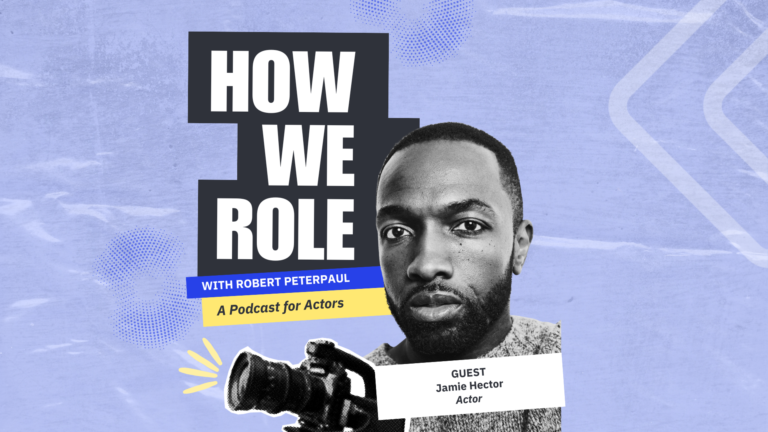

Casting director Tiffany Little Canfield of The Telsey Office joins host Robert Peterpaul on How We Role for a wide-ranging conversation about auditions, storytelling, and what actually makes actors stand out.
With credits ranging from Wicked and Verity to Ryan Murphy’s Monster and Paradise, Little Canfield has helped cast some of the biggest projects in film and television. In this episode, she offers a refreshing reminder that actors often overcomplicate the audition process when the real work is much simpler: tell the story.
In this episode you’ll learn:
- Why breakdowns are often more useful for agents than actors
- What casting notices in the very first frame of a self-tape
- Why “strong choices” don’t necessarily mean big choices
- The surprising psychology behind co-star and day-player auditions
- Why technical perfection matters less than most actors think
- How great actors establish character before saying a single word
One of the most valuable moments comes when Little Canfield dismantles the importance many actors place on breakdowns. While performers often search for clues about how to “get it right,” she explains that breakdowns are intentionally broad and shouldn’t be treated as a blueprint for performance.
“The breakdown is really for the agents,” she says. “It’s not actually—I’d take it with a grain of salt, honestly.”
Instead, she encourages actors to focus on the material itself. The writer doesn’t know you personally, she reminds listeners. If you don’t immediately see yourself reflected in the breakdown, that doesn’t mean you’re wrong for the role. The script contains far more useful information than a few descriptive lines ever could.
Little Canfield returns repeatedly to the idea that acting is storytelling, not test-taking. Too often, she says, actors approach auditions as if they’re trying to guess the correct answer rather than contribute creatively to the project.
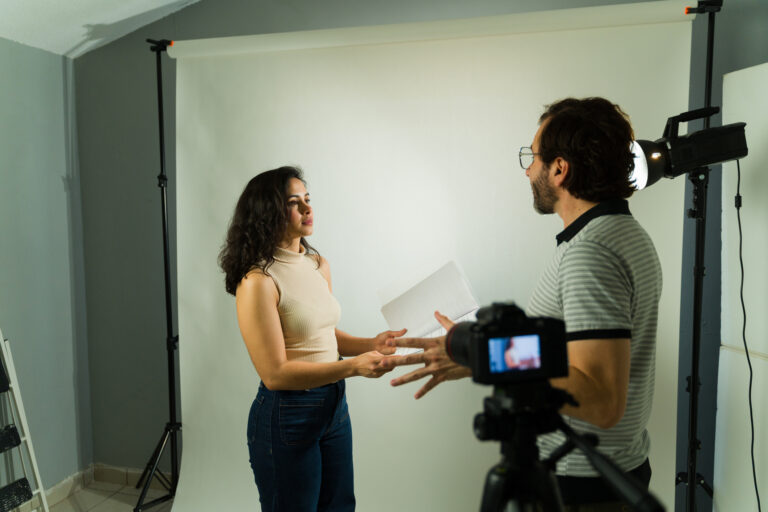
One of the clearest examples comes when discussing self-tapes. Asked what she notices in the first few seconds of an audition, she points to something far more fundamental than camera quality or lighting setup.
“What story is being told?” she asks.
For her, great actors establish an impression immediately. Before speaking, they’ve already made decisions about who this person is, how others perceive them, and what energy they bring into the scene. Whether the character commands authority, creates discomfort, or instantly wins people over, those choices are visible from the first frame.
That same philosophy extends to the phrase actors hear constantly: make a strong choice.
Little Canfield believes many performers misunderstand what that means. Strong choices aren’t about doing something flashy or unconventional. They’re about committing fully to a specific interpretation.
“A strong wrong can be more successful than something general,” she explains.
Even if the choice isn’t exactly what the creative team imagined, commitment reveals something valuable. It shows imagination. It shows preparation. Most importantly, it shows the actor is bringing something personal and specific to the material.
The conversation also offers an insightful look at co-star auditions, which Little Canfield believes are often more difficult than actors realize. The challenge isn’t the size of the role—it’s the psychology surrounding it.
Actors frequently dismiss smaller parts as unimportant, which limits their creativity before they even begin. Casting, however, doesn’t think in terms of hierarchy. The question is always the same: what does this scene require?
A memorable example comes from And Just Like That…, where a nearly silent restaurant waiter became one of the most memorable moments in a scene simply because the actor understood the circumstances and brought a fully realized point of view to the role.
Specificity, she argues, is often more powerful than size.
When the conversation turns to self-tapes, Little Canfield delivers perhaps the episode’s most reassuring takeaway. Actors obsess over ring lights, backdrops, framing, and technical perfection, but those things rarely determine whether someone gets cast.
Her priority is much simpler.
“I’m not in the business of casting good self-tapes.”
She’s in the business of casting great actors.
The Jonathan Bailey audition for Wicked serves as a perfect example. Recorded quickly backstage at a theater, complete with technical imperfections and background noise, the tape worked because it captured the qualities of the character. It wasn’t a perfect audition. It was the right storytelling.
Throughout the episode, Little Canfield continually returns to collaboration. Whether discussing actors like Anne Hathaway, Ariana Grande, Charlie Hunnam, or the ensembles she’s helped build on projects like Wicked and Monster, the common denominator is generosity.
The best actors, she says, understand that they’re joining an ensemble of storytellers. They’re not arriving to prove themselves. They’re arriving to help tell the story.
She closes with a perspective that feels especially valuable in an industry often driven by anxiety and perfectionism: stop trying to figure out the right answer.
Read the script. Trust your imagination. Make a choice. Tell the story.
Submit your questions for future episodes, and if you enjoyed this conversation, please share it with a friend and leave us a review!