
For thirty years, Heesom Casting has been the sole South Australian member of the Casting Guild of Australia.
Responsible for mega blockbusters (the Mortal Kombat franchise), International Emmy-winning series (First Day), iconic cult classics (Wolf Creek), beloved indie features (Storm Boy) and award-winning television commercials (Cannes Grand Prix winner, “Be Consumed”), Angela and Lou Heesom are the “go-to girls” for all things happening in Australia’s southern state.
Key Insights
- Self-taping has shifted power toward actors, offering more creative control while expanding access and opportunity across the industry.
- Luck opens doors, but only actors who are consistently prepared and deeply invested in their craft are ready to walk through them.
- Great acting isn’t about flashy choices but about work that feels fully alive, emotionally transparent, and impossible to ignore.

Heesom Casting was responsible for the Australian casting of Mortal Kombat and Mortal Kombat II. What can actors learn from your experience casting such major international co-productions?
That luck definitely exists! But you have to be ready for it when the moment arrives.
Mortal Kombat came to us through the legendary producer E. Bennett Walsh. This man’s credits literally define eras in cinema! Meanwhile, we were these little-known Adelaide-based casting directors who, while having had the privilege of working on some seminal Australian productions, had never worked on that international scale before.
Yet, for whatever reason, Bennett saw something in us and was willing to take the chance. That was the moment that changed everything. Suddenly, we were working on the Australian end under US casting director Rich Delia, watching pure mastery in action.
But none of this could have happened without Bennett. We’ve now made three films together, and I can honestly say I owe my career to the belief of that man.
I think that, in many ways, it’s the talent-based philosophy that has been the universal thread in all three productions we’ve done together. These highly revered giants of film really give weight to the power of instinct, and that when someone walks into the room and has that magical quality, you trust that.
You don’t always have to wait for the CV to give you permission to hire. You back the talent, you back the actor and you back the work. Across these three productions, we’ve been able to cast actors in key supporting roles who, at the time of auditioning, had nomajor film or television credits.
You never know when your big break could come. It could be your next audition, your next tape. But you have to be ready. You have to keep up the momentum — working, stretching and deepening your craft. And do it not for the credits or fame, but for the pure joy of the work.
As casting directors, we see all of that. We see all those hours of unseen preparation, the heart, the craft and quiet sacrifice. When that’s all coalescing inside of you, that’s what sets your work on fire when the big moment arrives.
Your team has almost as many TV credits as film credits. How does self taping or auditioning for a series differ from self taping or auditioning for a feature?
It’s subjective, but for me personally, I don’t think there are specific rules for feature auditions vs. episodic auditions. Of course, you have to do the right research in terms of genre and tone of the filmmakers, plus the rhythm of the writing, so your work lives within the same universe.
However, at the end of the day, all we are truly looking for is good work. Work that is fully formed, honest and teeming with life. It’s always about how the actor brings themselves to the part and expresses this in artistic terms.
For general advice, and this is not a blanket rule, but for episodics or features that have a writer/director, actors should stay true to the text, and not assume they can improvise or be too loose with the dialogue. Often, writers are also watching the auditions, and by the time we’re at the casting stage, they’ve spent years honing the language.
If you want to improv, I always suggest doing the first take as written. Then, if you want to offer something more unique to you and your sensibilities, deliver it in a second take. Then you are honoring both creative partners: the writer and you, as the actor.
You joined Heesom Casting in 2009, so you’ve had a front-row seat to the many shifts and changes the industry has undergone in that time. What realities do you believe today’s actors most need to be aware of?
Casting wasn’t an industry sector in South Australia before my mom, Angela Heesom, created it over thirty years ago. I’ve seen firsthand the grit behind the glamour, the depth of her craft and her dogged determination. She cares so deeply about our industry. A lot of that has informed my approach as well.
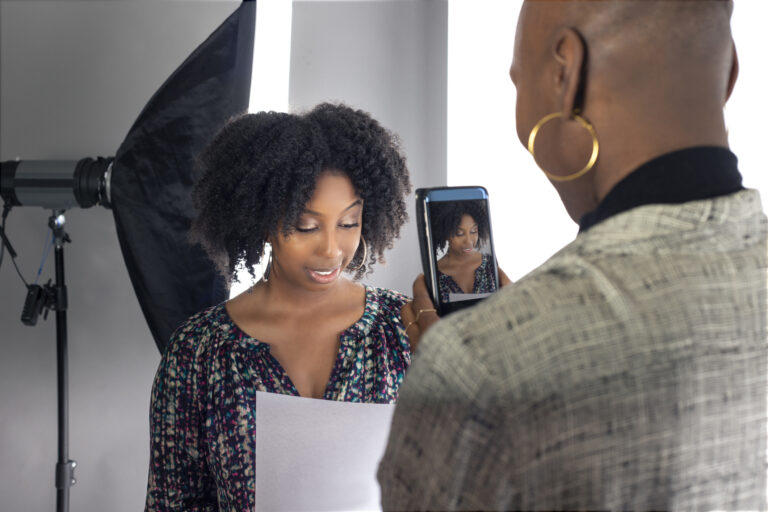
Yes, the landscape has undergone radical evolution, particularly with technology. The great conversation piece is, of course, self tapes, which have now become a routine entry point for first-round auditions. But all casting directors mourn the days of solely in-the-room auditions.
That was our lifeblood — that exchange between us and the actor, together mining the material for all its infinite possibilities. Most of my friends are actors as well, so that sense of daily community has really shifted and taken some adjustment.
Yet we can’t resist technology; we must embrace it and evolve alongside it. Where we once would have seen four or five actors each hour, I can now watch twenty self tapes in the same amount of time. That has undoubtedly widened the horizons and given greater permission for experimentation, because I’m not limited by the time available in the room.
Tapes have become a great democratizer. We can push the envelope more than ever before to challenge, to give space for new voices and spotlight communities not represented, or authentically represented, on our screens. So, I’m truly grateful for the power of that.
Plus, it can give actors a sense of agency. You know the audition you do, and then on the way home you suddenly realize all the ways you could have done it in the room? That no longer exists. You have complete creative control. [With a self tape], you can hone and develop it until you are totally satisfied. I’m constantly marveling at how actors arrive at such precise and imaginative interpretations of the material. It’s wild watching a great creative force be creative.
Similarly, you’ve mentioned that simply being “good” just isn’t enough. In your eyes, what separates the good actors from the great?
That’s a difficult question. Quite frankly, Australian actors are extraordinary. Beyond world class! We’re currently casting an ensemble film and it’s almost impossible to arrive at any type of shortlist because, audition after audition, every actor’s work is just so good.
Then, all of a sudden, an actor walks in or a tape arrives that transcends everything that came before them. Not because of a specific choice they made, or some bold idea they’ve inserted to make their work stand out, but because the work is so organically alive. It breathes. There’s an emotional translucence and an energetic undercurrent that makes you hear the material anew.
I always know when an actor has achieved that. Something almost leaps through the lens and into your body. By the end of the scene, not only have I forgotten to call “cut,” but I’ve completely stopped breathing. Literally. Because the actor has me so fully suspended in that moment, I’ve forgotten that there’s a script and we’re just two people in a room reading a scene.
That’s what’s so exquisite about that level of craft and execution. While it looks effortless, it carries the weight of a lifetime. For me, that’s what separates the good from the great. It’s lightning in a bottle.
Your Screen Acting Masterclasses constantly sell out. If you had to guess, what would you say is their secret sauce?
I wish there were a secret sauce! If there is one, it’s the actors themselves. I’m continually in awe of the level of talent and commitment they bring to the room. The classes are such joyous spaces full of experimentation, risk taking, discovery and laughter.
At the same time, they’re deeply practical. I feel a real responsibility to ensure every actor leaves with tangible, actionable tools they can use immediately, because in auditions, the window to bring material to life is so fleeting. It’s a high-pressure environment, so my focus is always on keeping the actor open and accessing their best work.
There isn’t space to dismantle what they’ve prepared, even if something isn’t fully serving the material, because in that moment the actor tightens and I lose access. In the masterclass, we’re given the rare gift of time.
Ultimately, it’s about giving back autonomy and creative control. Helping actors understand their process, trust themselves and acknowledge the extraordinary artistry within them. Then it’s about elevating that work to its fullest expression, and giving permission for their entire being to completely fill the frame.
What’s the best way for emerging actors to get on the Heesom Casting radar?
Knowing good actors is a casting director’s currency. We’ve always got an ear to the ground!
However, I also don’t sit in an ivory tower making all the decisions alone as to who I bring into the room. So much of this job is about collaboration. Collaboration with our team, and importantly, collaboration with agents. Agents don’t get nearly enough thanks for what they do, or the hours they work. They work harder than anyone in this industry.
If you can find an agent who really believes in you as an artist, please know they will literally kick my door down to make sure I’m seeing your work or giving you audition opportunities. If an agent or manager calls me and says I have to see this person for this role, I generally trust that.
If you don’t have an agent, however, it’s about putting yourself out there. And I know that is hard when you are first starting out, but work truly begets work. Do local theater, star in your own web series, make a short film and put it into the festival circuits. Oscars have been won by films made on iPhones. Actors have so much more agency than ever before.
Be reassured that if you’re doing good work, you will get noticed. It’s our job to notice. Stay curious, stay engaged and stay passionate. That energy, that love for the process, fuels everything you do and is always visible. Remember, no one can take away your right to be an artist. It’s a game of luck, perseverance, passion, preparation and opportunity.
Embrace the work. Hone your craft. Trust your instincts. Be bold, be daring and never stop believing in the artist within you, as the only sure way of not having a career in this industry is by giving up.
Amen! Finally, any films or series you’ve seen lately that should be on every actor’s watchlist?
I’ve actually been revisiting some old classics and am into the final season of The Sopranos. But I’m obsessed with the Brazilian film I’m Still Here directed by Walter Salles. Plus all three seasons of The White Lotus, The Correspondent (cast by the incredibleAnousha Zarkesh) and Bring Her Back by local Adelaide legends, the Philippou brothers.
Looking back to 2024, Ripley was a masterclass in establishing tension through silences. The volcanic internal life all those actors brought was breathtaking. Such a great example of how doing less is always more, when the internal life is fully supplied.
Every actor should be across all series and films being produced in this country. Know your casting directors, producers and directors. Notice who they are casting and ask yourself why. How can you speak to their sensibilities, and film self tapes or scenes that deliver that as explorations?
This interview has been edited and condensed.
Special thanks to Lou Heesom for her time.