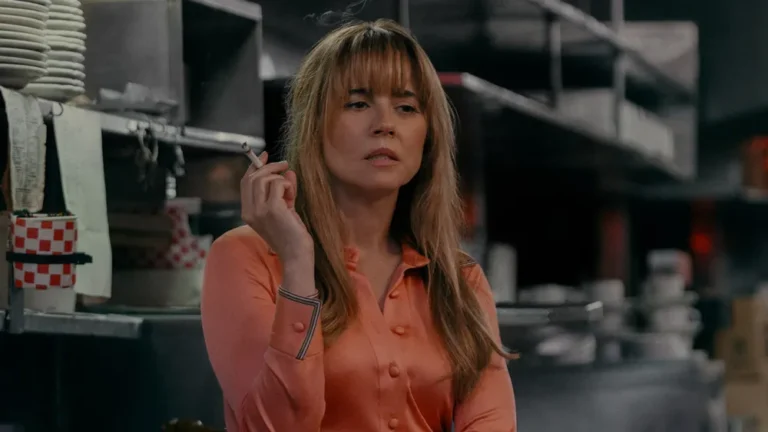

Stepping into a legacy horror franchise often forces actors to navigate a delicate balance between homage and reinvention, and in Peacock’s upcoming series Crystal Lake, premiering on October 15, Linda Cardellini tackles the legendary role of Pamela Voorhees.
Originating as the grief-maddened killer portrayed by Betsy Palmer in the 1980 film Friday the 13th, the character has lived in the pop-culture consciousness as an archetype of slasher vengeance.
Key Insights
- Anchor every choice to one relationship: Cardellini filtered every scene through Pamela’s bond with Jason, even when her behavior seemed unrelated to him.
- Don’t imitate an iconic performance; chart the emotional path that leads to it, since Betsy Palmer’s Pamela couldn’t be replicated.
- Treat horror as athletic work, because the physical exertion of a long, demanding stunt sequence can unlock real emotion and inform the rest of your performance.
Crystal Lake reframes the narrative as a psychological prequel, exploring the era when Pamela was simply a devoted mother fighting to protect a vulnerable child. In a recent press conference for the series, attended by Casting Networks, Cardellini and showrunner Brad Caleb Kane discussed the specific craft decisions, physical rigor and psychological mechanics required to track that tragic devolution.
For Kane, the appeal of revisiting the franchise lay in exploring Pamela’s psychological blank slate that precedes the original ’80s slasher film.
“Even though we know the story of Pamela Voorhees from the first movie, her life is pretty unexplored,” Kane explained. “There’s a lot of life that you live before the events of that first movie that take you to the place where you’re going to avenge your son over and over and over again. How did she get to the place where we know her in that first movie? She’s obviously somebody who’s gone through a lot, and we all have questions.
Cardellini echoed that sentiment, emphasizing that her goal was never to replicate what came before, but rather to chart the emotional path that leads to it.
“I watched the movies again, especially the ones with Betsy Palmer,” Cardellini said. “The beautiful thing about it is, Betsy Palmer’s performance is just undeniable and unforgettable and totally singular, so you can’t do what she did. But the idea that you can create a character that gets to where she is in that first movie was fun for me.”
To build that bridge believably, she had a clear objective to ground Pamela’s extreme choices: everything routes directly through Jason.
“The key to Pam is that everything is about Jason,” Cardellini stated. “Everything she does is for him. The closeness that they have when he is young is the thing that she takes with her until that first movie.”
“You’re understanding the making of the monster, her and him,” the actress said. She feels that establishing that mother/son dynamic was important, because the audience meets Pamela at that point in her life where she was a protective mother to a bullied son.
That throughline gave Cardellini a filter for every scene on set, even when Pamela’s behavior appeared completely disconnected from her son.
“To get into her headspace [as an actress] for me, everything’s about Jason,” Cardellini noted. “At the heart of everything she does, even if it looks charitable, it’s really an effort to bring him back to her. She wants to stay connected to him by any means possible.”
As that maternal protection gradually curdles into violence, Cardellini had to navigate a character who, in her complete devotion to her son, lost her own identity, morphing into a violent killer.
“She loses [her identity] so much that she becomes somebody else, which I think is the fun part of her journey, and then we all know where she ends up in the first movie,” the actress observed. “The idea was, who was this person before? Then, how does she lose herself? And then, how does she become so misguided?”
Beyond the psychological prep, Cardellini discovered that accessing the character’s bottled fury required plenty of physical exertion. During one particularly demanding stunt sequence involving an extended kill, the physical labor of the action triggered an unexpected emotional gateway.
“The rage is so important, and it’s so undiscovered, and it was one of the things that I really loved about the character,” Cardellini recalled. “There was a moment on set after the first kill that I have where it’s been such a long, arduous kill that the body is there and I just hit it.”
The actress explained that production set up a rig where every time she hit the body, blood would splash her, with the camera below capturing her face getting sprayed with blood.
“They let the take go really, really long, so for a good amount of time I punched a bag over and over and over again. I was screaming and yelling and crying. I had a physical exhaustion along with the physical exertion that I had never done on screen as a character before, and maybe even in my life before.”
In that moment, Cardellini revealed she felt connected with the rage Pamela must have felt, and understood how good it would have felt for the grieving mother to get that out of her system.
“The actual physicality of going through that … informed me for the rest of the show,” Cardellini said. “I could see where you could [get] addicted to that adrenaline release. Maybe that’s what happens to her, where she feels like she’s in control or she’s letting something out or she’s finally able to be her true self or finally getting back at people for all the things that they did to her. That was a really interesting moment that was totally unexpected for me.”
Kane pointed out that this explosive release makes structural sense within the narrative context of the era and the character’s history.
“Having been manipulated and gaslit and … having gone through everything that Pamela goes through in her past, you can only suppress that rage for so long,” Kane said. “It felt very natural that that would come out, based on what you knew about the character.”
Cardellini also found it interesting to be “on the other side of the knife,” where she was pursuing and chasing, not the other way around. “There’s a certain amount of decision and control that goes into playing that [type of] person. To operate as the killer in that world, you are on a different wavelength than everything else that’s happening around you. That was really fun to explore.”
The horror genre itself requires a different level of endurance for an actor.
“Horror is challenging in its own way that is separate from anything else,” Cardellini said. “The physicality of horror is a workout every single day. I remember coming home and having bruises everywhere. Even though I have an amazing stuntwoman, it is inevitably incredibly physical.”
Cardellini’s commitment to the bodily toll and the psychological preparation made Kane’s job on set simple:
“I just stand back, and I let Linda do her thing,” Kane said. “She understood the character in and out. She understood the franchise. She understood what fans wanted. She did the work, and you saw that every day on set. It’s an incredibly demanding role physically, emotionally … and she gave it 100 percent every single day. There was really nothing for me to do but sit back and let Linda cook.”
Conclusion
Cardellini’s approach to Pamela Voorhees shows that playing a legacy character doesn’t mean copying what came before. Find the single motivation that drives the character, build backward from where the audience already knows them, and let the physical demands of the genre feed the emotional truth of the work.
For actors, the takeaway is to do the preparation that lets you commit fully, then trust it on set.