
When an actor books a role in an ensemble project, one question looms large: How do you manufacture decades of shared history, trust and chemistry with a group of strangers?
Setting the stage for this exact creative challenge is Peacock’s original series, The Five-Star Weekend. Based on the bestselling novel by Elin Hilderbrand, the series centers on Hollis Shaw (Jennifer Garner), a popular food blogger, who in the wake of her husband’s sudden death organizes a curated girls’ trip to her Nantucket home.
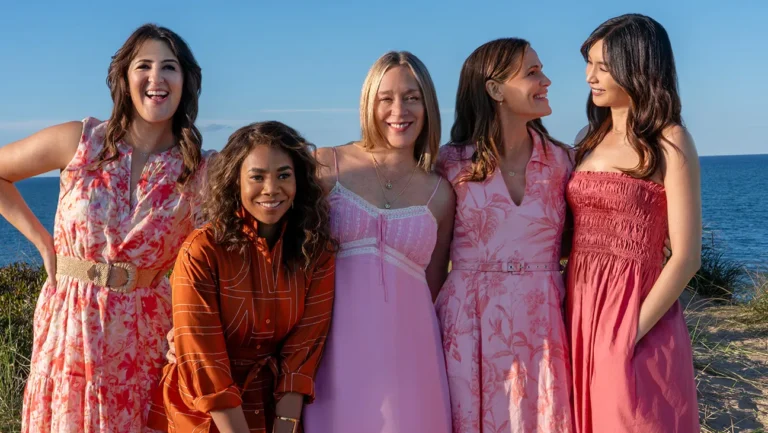
The premise gathers four friends from completely different eras of Hollis’ life: her childhood (Chloë Sevigny), her college years (Regina Hall), her early motherhood days (D’Arcy Carden) and one online follower (Gemma Chan) she befriended after her husband passed.
By forcing a group of mismatched personalities into a single house, not to mention surrounding characters like a gossiping frenemy (Judy Greer), a hometown ex-boyfriend (Timothy Olyphant) and Gen Z offspring, a lot can spark or combust over the course of a long weekend!
At a recent press conference for the series, cast members Sevigny, Chan, Carden and star/executive producer Garner pulled back the curtain on how they brought this dynamic friend group to life.
Key Insights
- Strong ensemble chemistry comes from genuine off-screen connection, with the cast building trust and intimacy during downtime to create believable decades-long friendships.
- The actors found the series’ balance of humor, grief and emotion through experimentation, collaboration and a willingness to try different approaches from take to take.
- By rejecting stereotypes and bringing vulnerability and complexity to their characters, the cast created richer performances while Jennifer Garner’s collaborative leadership fostered a supportive environment for creative risks.

Discovering a Shared Tone
For an ensemble piece to seamlessly shift between humor and devastation, the performers listened and adapted to the group’s collective frequency in real time.
This balance was especially delicate when Hollis masks profound tragedy with forced joy. Garner explained that her biggest obstacle was portraying Hollis’s complex internal emotional duality without letting the sadness take over the entire performance.
“The biggest challenge was that Hollis is really trying to push through grief,” said Garner. “She’s trying to put it on another shelf and not have to deal with it. She’s trying to distract herself to make things beautiful, in lieu of feeling what she really needs to feel. The reality is, grief is gonna sneak up on you. It’s right under the surface all the time.
Playing both of those things tonally so that Hollis is almost giddy with leaning into being with her friends, and at the same time, right under the surface, grief is lurking, was probably the trickiest part for me.”
To find this baseline, the cast experimented with various performance choices as a group. Sevigny detailed how the actors worked to discover the project’s exact frequency by trying different things from scene to scene.
“When we started shooting, we were all a little like, ‘What is the tone?’” Sevigny recalled. “We were trying to find the tone and we were allowed to do different interpretations with every take. For me as an actor, I wanted to be funny, but I wanted to be really emotional and very grounded. That was kind of new for me.”
Guiding them was director Minkie Spiro, whom Sevigny described as “demanding in a good way” in terms of getting the best performances out of the group.
“She often was asking you to reach for something maybe you wouldn’t think of and do another take,” Sevigny shared. “But I think she also pulled a lot out of us. She came up with a lot of ideas or approaches to a scene or a line that we wouldn’t have thought of.”
Bypassing Small Talk in the Off-Hours
Manufacturing decades-deep history is especially challenging when the actors themselves have no prior relationship. Garner revealed that despite their on-screen ease, the Five Star group of women were strangers before production began.
“None of us had met,” Garner shared of her co-stars Sevigny, Carden, Hall and Chan. “None of us had worked together.”
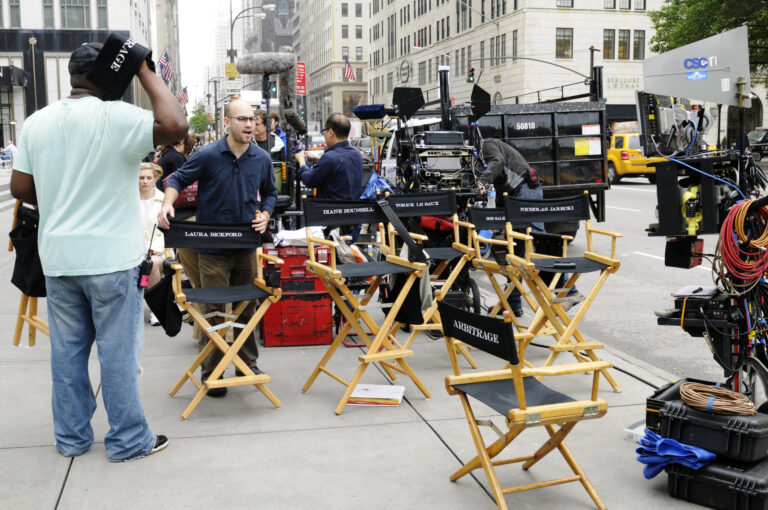
The group took as many moments as they could to build intimacy in their downtime on set. “The grips and electrics and cameramen were setting up the shot,”
Garner recalled. “We were back there [offstage] … getting deep, getting personal right away. They would come back to say, ‘We’re ready for you on set,’ and we would just be like, ‘What? We’re talking. This is the work!’ That was the most important and valuable thing we did all summer.”
During the shoot, the group even went together to the cinema to watch Hall in the feature film One Battle After Another. “We stood up and gave her a standing ovation at the end of the movie,” recalled Garner. “It brings tears to my eyes because we got to celebrate our girl!”
Carden agreed that this instant creative intimacy cannot be manufactured, but rather flows from an authentic willingness to connect. “You can’t force that,” Carden stated. “It was so easy and organic, and everybody got along so well. It was one of the best experiences of my life.”
“Very early on, we all kind of melted into each other,” Garner added. “There was an instant and very deep ease amongst the five of us, and it really worked to our advantage.”
Elevating Each Other by Subverting Archetypes
An ensemble dynamic thrives when actors elevate the text with authentic character portrayal rather than stereotypes. Chan emphasized this mindset when approaching her character, Gigi, a pilot and “internet friend” to Hollis. Her Gigi hides a secret: she was having a year-long affair with Hollis’s recently deceased husband, Matthew.
Chan worked intentionally to ensure her character brought depth to someone who could easily be described as a homewrecker. “There’s another version of the show where [Gigi] could be portrayed as the villain of the piece,” Chan explained.
“But I know it was really important to Elin, the author, and Bekah [Brunstetter], our amazing showrunner, and also to me, that Gigi was not portrayed that way. Yes, she’s made mistakes. She’s a flawed, imperfect human being, and there are consequences to her actions, but she’s just trying her best.”
This commitment to dimensionality extended to the entire cast, with Chan praising co-star Greer for elevating the character of Electra, far beyond what was originally written on the page.
“What Judy Greer did that I thought was remarkable is that on the page, Electra is just an out-and-out B-I-T-C-H,” Chan shared, noting how Greer brought unexpected layers of feeling to the performance.
“Acting in scenes with her, she would bring this vulnerability behind her eyes that was so sad … There’s a moment when Gigi tells Electra where to go. Electra’s mask drops, and that is Judy’s skill: suddenly [her character is] human and you see that this woman … is terrified of being left behind or not having friends.”
When every actor commits to playing multi-dimensional truth rather than the stereotype, the entire group dynamic becomes richer, allowing scene partners to react to genuine human vulnerability rather than flat caricatures, as evidenced in the series.
The Star-Producer Advantage
An ensemble can only take bold, vulnerable risks if the environment on set is anchored by mutual respect, and that tone is often set from the very top of the call sheet. Serving as both the series lead and an executive producer,
Garner cultivated a collaborative workspace for her fellow actors. Sevigny noted that Garner brought in department heads and assistant directors she had trusted and worked with previously for decades, which only reinforced the ease and spirit of collaboration.
Added Chan: “We also had an amazing team of producers and writers and directors who are all women.”
For Garner, the priority was building a leadership team, above and below the line, based on merit and capability. “They weren’t there because they were stunt-cast as the ‘Let’s have all female directors.’ They were the best people for the jobs, and they were so unbelievably competent, prepared, professional, artistic, creative, ready to go.”
This high level of professional trust behind the scenes created the ultimate safety net, allowing the actors to sink into the ensemble work and trust the safety of their creative sandbox. Said Chan: “We couldn’t have asked for a better leader who made everybody feel heard and valued both as the star and the producer.”