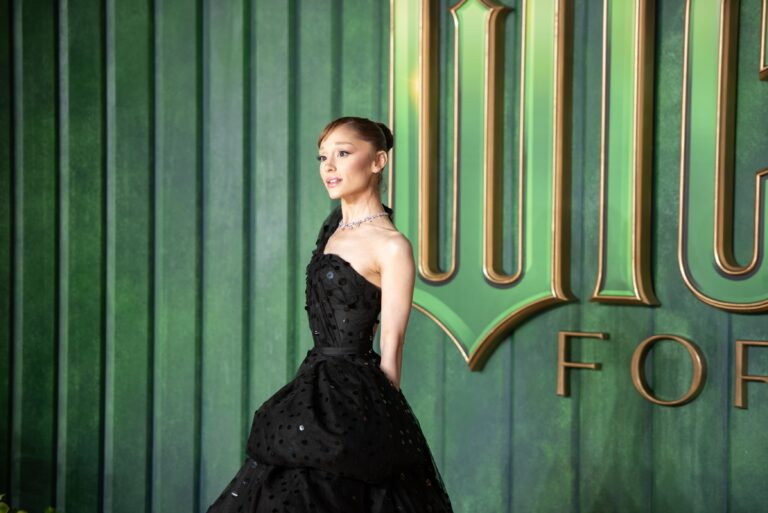

After last year’s blockbuster success of Wicked, the feature film adaptation of the first half of the Broadway musical, Wicked: For Good, concluded the story of Glinda and Elphaba.
At a press conference for the film attended by Casting Networks, Ariana Grande reflected on her journey playing Glinda, a role that earned her Oscar, BAFTA, Golden Globe and Critics’ Choice nominations for Part One. Though the 2026 awards season is still in its early stages, Grande has already received both Golden Globe and Critics’ Choice nominations again this year for Part Two.
Key Insights from Ariana Grande:
- Front-load your technical prep. Train your voice or physical skills in advance so that the technique is “muscle memory” and you can focus entirely on emotional honesty with your performance.
- Map your character’s “invisible” history. Create a detailed timeline of your character’s traumas and triggers — even those not in the script — to ensure your reactions on screen are rooted in a lived-in reality.
- Visualize your character’s emotional arc. When filming out of order, using a color-coded system or “sticky tabs” to identify specific insecurities or motivations in any given scene can help you quickly anchor yourself in the moment.
- Combat burnout with skill-building. When the pressure of the business becomes overwhelming, “bury yourself in the craft” by taking a new class or learning a technical skill to stay connected to your love of the art.
When asked how Glinda evolved across the two films, Grande explained that both were shot simultaneously: “Monday, Tuesday, Wednesday of the week we would be filming Part One, and then Thursday, Friday, Saturday we would be filming Part Two.” In other words, there was no stepping back into Glinda’s shoes — they were always moving forward with the story.
Yet the full evolution of Glinda had been mapped out by Grande well before filming began. “I wanted to make sure I knew who she was before we even [started]. Even things about her that you never got to see on screen… I wanted to make sure that beneath the bubbly, shiny, perfect exterior — bubble of privilege, I like to call it — there’s a person underneath that has a lot of insecurities, a lot of little wounds that contribute to her need for all that external validation.”
For Grande, this meant charting Glinda’s journey from childhood, understanding how the future Good Witch acquired beliefs that shaped her, and even identifying “triggers” that might never appear on screen, but informed her performance.

“Her childhood was something that I referenced a lot — where those traumas started, and mapping out her insecurities,” Grande said. “I used a color-coding system. I had sticky tabs, and I would have a tab for each insecurity or emotional thing that was peeking through. I wanted to map it all out so that in my brain, I knew where everything was coming from before we got to set.”
She added, “If you know the person from the inside out before you get there, you can throw everything away and forget about it, and then respond honestly in the moment. That’s kind of my favorite thing: that spontaneous call and response that we do as actors.”
Grande also shared insight into her vocal preparation. Before her first audition, she undertook three months of daily vocal training, much like her character work, so that “I wouldn’t have to think about how the (musical) notes were going to come out in the room, and I could honor the honesty of what’s happening in the scene.”
“It wasn’t easy. I’ve loved these songs since I was 10, so I don’t know that I needed to learn them [per se], but I needed to be able to bring my own point of view and honesty to them. That was a tall order.”
The biggest challenge, she said, was retraining her voice to match the more classical tone of Glinda’s voice, which she explained is a “coloratura soprano.” That voice type is typically known for its light, bright and sparkling quality, as well as the ability to execute rapid scales, arpeggios and trills.
“I needed to spend a lot of time retraining the muscles of my voice to know how to do that, and to create a rounder, fuller, warmer vibrato, and get there technically so that I would sound legitimate,” said Grande.
As much preparation as she did for the role, preparing for the type of audience reaction to the films was not something she could plan for. “It’s really overwhelming. It’s really beautiful. There is nothing that you can do to prepare for this kind of response. I’ve loved Wicked my entire life. I loved it the way that [current fans] love it now. But you can’t assume they are going to embrace your version of it.”
During filming, she said the cast had to shut out that pressure and stay focused on the work in front of them, rather than worrying about whether their adaptation would be accepted. Looking back now, the scale and passion of the Wicked fandom that emerged was, according to Grande, “impossible to imagine — they are the best and most loving in the world!”
Reflecting on her journey from Nickelodeon child actor to full-fledged musical and movie star, Grande emphasized the importance of a strong support system. “Bring your family, or your chosen family, your best friends along for the ride,” she said. “Because sometimes, being a performer can be tricky to navigate, and it’s important to have support.”
And when the pressures and distractions become too intense, she said, returning to one’s craft is essential. “Go back to your acting coach, to your classes, read something, write a song, learn a new skill, teach yourself Pro Tools,” she advised. “Just bury yourself in the craft! Don’t let anything disconnect you from what you love about doing this. Keep coming back to your craft.”