
Casting director Jennifer Venditti has long been known for blending established actors with first-time performers, introducing audiences to emerging talent like Euphoria’s Angus Cloud and Hunter Schafer, Uyghur actress Sebiye Behtiyar (nominated for Breakthrough Performer at this year’s Gotham Awards for her role in Preparation for the Next Life), and Julia Fox in Uncut Gems, directed by Josh and Benny Safdie.
This year, Venditti continues that approach across several major projects, including Benny Safdie’s The Smashing Machine and Josh Safdie’s Marty Supreme. Venditti spoke to Casting Networks about her collaborations with the brothers, and her continued search for authenticity in performance.
Key Insights
- Jennifer Venditti’s casting philosophy centers on pairing trained actors with non-professionals to create performances that feel raw, unpredictable, and rooted in real life.
- Collaborations with Josh and Benny Safdie rely heavily on trust, deep archives of discovered talent, and an instinct for faces and lived experiences that translate cinematically.
- Casting even the smallest roles demands the same care as leads, ensuring every character leaves a lasting impression on the audience.

You’ve known and worked with Josh and Benny Safdie for many years. Tell me about your relationship with them.
In 2007 I made a documentary calledBilly the Kid. They saw the film and were like, “Oh, she sees the world the way we see the world.” We’re all very much into the cinema of real life, and exploring how someone’s lived experience — whether they’re a professional actor or a non-professional actor — can blend with what’s written on the page.
We’re always trying to pair someone who understands where a scene is going from a structural storytelling point of view with someone who has no idea about that, but brings their own magic and mystery. We love what happens when you join those two things together.
The Smashing Machine is a biographical drama starring Dwayne “The Rock” Johnson as MMA fighter Mark Kerr. You and Benny populated the film with many real-life fighters throughout, from major roles to supporting ones. MMA champion Ryan Bader, for example, plays wrestler Mark Coleman, a close friend of Kerr’s. What was challenging about auditioning non-actors for this film?
I’m in New York and can bring people in who aren’t experienced and work with them in person. With The Smashing Machine, we couldn’t do that because we were casting people from all over, so everything was on Zoom. For non-actors, Zoom can be hard. It’s already a weird thing for them to have to audition, and now they’re doing it through a video screen. But Benny was amazing. He would show up and do improv, help direct them, and we’d do it together.
How did you manage to cast Ukrainian professional boxer Oleksandr Usyk, a three-time undisputed champion, to play the role of fighter Igor Vovchanchyn?
I go down these rabbit holes, looking and looking and watching videos. Benny and I were like, “This guy is so cinematic. He’s so interesting!” Then I contacted his manager (Serhii Lapin). Oleksandr’s work schedule was insane! The fact that we worked that out — Benny was over the moon.
Also, Oleksandr’s manager ended up being in it too, playing the character’s manager. Benny loves stuff like that. The more it can mirror reality, the more he loves it, because it brings a certain energy to everyone on set — not just for the film, but to The Rock’s and Emily Blunt’s performances.
These guys have something they can bring from their lived experience to the project.Oleksandr really wants to act, and I feel like this project was just a taste for him. I hope we can find something else for him.
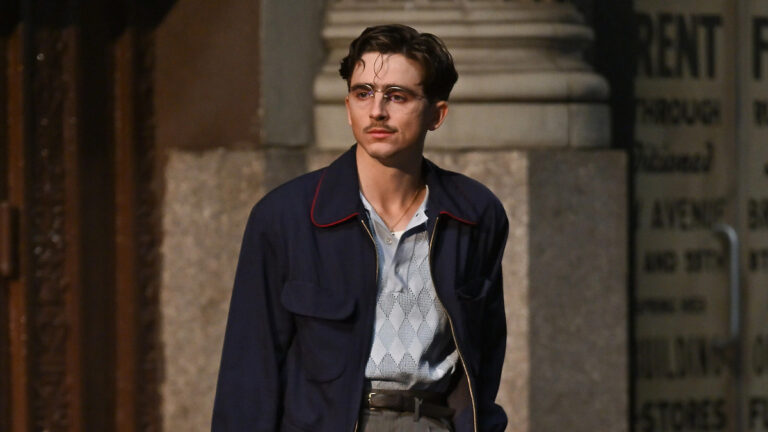
You worked with Josh on Marty Supreme, starring Timothée Chalamet, and loosely based on Marty Mauser, a young man in the 1950s who dedicates himself to becoming a professional table tennis champion. You had about 140 roles to cast, filled by both actors and non-actors. Where do you start?
I’ve been working with Josh for so long, and there are projects we’ve worked on that never came to fruition, so we have tons of lists and archives from street scouting and amazing actors we’ve met in the past who never got to be in any of our projects. I put together some names right off the bat without even fully auditioning people, and Josh and I went over that.
Can you share a few examples?
There was an incredible guy we had loved before, but never got to use, and we cast him as one of the cops in Central Park. In the bowling alley scene, there was a menacing tall guy with big eyebrows and an insane face. He’s someone we had scouted previously, so we brought him in.
Fran Drescher (who plays Marty’s mom), is someone we were going to cast for a project that didn’t go through. Luke Manley (who plays the heavy-set Dion) was someone we found on social media. He came in and we did tons of improv with him. He was so great and incredible.
Let’s talk about the most notable non-actor casting in the film: Kevin O’Leary, the Canadian entrepreneur and investor, best known for the reality series Shark Tank. In the film, he plays Milton Rockwell, a wealthy businessman married to an actress played by Gwyneth Paltrow. How on earth did this come about?
We went through lists and lists for Milton. When Kevin’s name came up, we didn’t think he was going to do it. I remember trying to get ahold of him. It was impossible because he’s a very busy person, and his people aren’t talent agents, you know what I mean?
Finally, we got through, but still, the guy is scheduled within an inch of his life. But Josh and (co-writer/producer) Ronald Bernstein flew to meet him and convinced him.
What made Kevin a compelling contender for the role of Milton?
I think what Kevin has — the quintessential kind of formula for Josh — is that he’s performing this persona, whether he can act or not. You see it inShark Tank. He has a persona, and there are elements of that persona that would translate to who Milton is.
Josh sees in people what they can’t see in themselves, and with this type of casting, it takes a director who knows how to really take it home. Josh knows what it takes to make someone like this successful on set. Not everyone does.
He takes the time and effort to create a very safe, comfortable environment. Josh is an amazing coach, and that’s what a good coach does: they’ve got you, but they also challenge you to go beyond what you see in yourself. Josh is a master at it.
Musician Tyler, the Creator (Tyler Okonma), also makes his acting debut here as Marty’s friend Wally, who drives him around during one unforgettable evening when things get out of control. How did he become part of the cast?
Tyler was someone who was already set to be in this film. He’s someone Josh met years ago and was like, “I am putting him in this movie,” because, first of all, his face is so perfect for the time period. And also, he’s a performer. I love that scene with the car where Wally and Marty are dancing.
The film’s major female breakout is Odessa A’zion, whose character Rachel is married, but having an affair with Marty. What made her the right choice for this role?
I have been obsessed with Odessa forever. She auditioned forEuphoria, and I knew she was incredible. While we were casting this, she was working on a movie in Budapest.
I had her send in a self tape. When I saw it, it was just done. I knew she was the one. But I wanted to help her get to the place that Josh would be able to see it too.
What was the scene you worked on with her?
Her audition was the phone booth scene. She did it in the middle of the night because she was working during the day. She found a phone booth in Budapest. After doing it a few times, I was like, “This is cinematic gold.” Her audition could have literally been in the movie.
I sent it to everyone and it was unequivocal. Within seconds, Josh was just like, “Oh my God!” I think she’s so special and so singular. I’m so proud of her.
It’s amazing how much care goes into these roles, even if it’s a cop in Central Park with only a few lines or a leading role.
The reason why Marty Supreme is so incredible is because of the tapestry of all the humans in it. Whether it’s someone with one line or someone with a hundred lines, Josh literally treats them the same. The care that goes into finding that person and developing that person is the same.
Sometimes people around us get frustrated, like, “This person has two lines, why are we spending so much time seeing so many people?” Some of these smaller roles probably took longer for us to cast.
Why longer?
The casting challenge on a film like this is finding those singular people with so much texture that even one line permeates your brain after you leave the theater.
It’s about working with them to the point where they bring their own magic to someone else’s words, and making the audience believe them. They don’t just show up and do that.
Does that apply to the background actors as well?
I don’t cast non-speaking roles, but on this film, we cast a lot of background, too. Many who didn’t work out for the acting roles, we passed along to background casting. Normally I try to do that because we believe every face is important.
What’s your biggest advice to actors auditioning for you?
Live. Don’t be thinking about acting all the time. Go have life experiences. That is what’s going to make you a great actor. The people I’m drawn to are interesting people that have had life experiences.
Go become a fully formed, complicated person. Connect to what your authentic signature is. That is what I believe, one hundred percent.
Key Takeaways
- Authenticity in casting often comes from embracing non-actors whose real-world experiences add texture that can’t be taught.
- Strong director–casting director partnerships are crucial when guiding non-traditional performers to succeed on set.
- Actors benefit most by living full, complex lives, as personal experience is the foundation of compelling, believable performances.