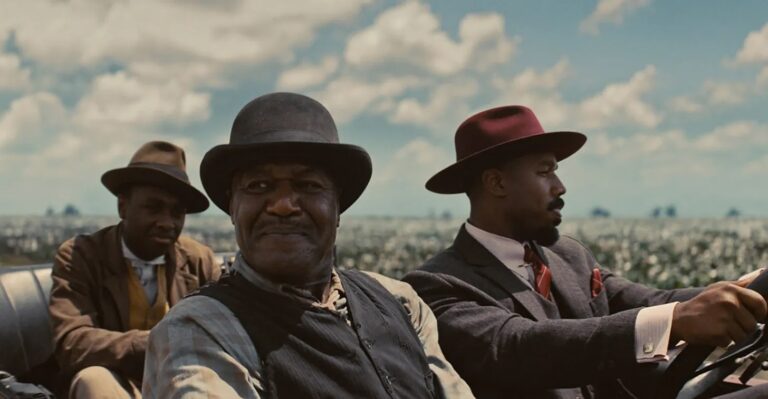

The cast of Ryan Coogler’s Sinners is nothing short of outstanding. Alongside the film’s inaugural Oscar nomination for Best Casting, Delroy Lindo and Wunmi Mosaku earned supporting acting nominations, while Michael B. Jordan is recognized in the Best Actor category. Rising talent Miles Caton has also begun to rack up accolades, including a Best Young Actor win at the Critics’ Choice Awards.
Set in 1930s Jim Crow-era Mississippi, Sinners stars Jordan as twin brothers who return home to open a juke joint. What begins as a bid for community quickly turns darker, as the film blends historical drama with horror, forcing the brothers to confront a supernatural evil in the form of vampires.
Key Insights
- Deep historical and musical research grounded performances in authenticity and cultural truth.
- Trust-building rehearsals and personal storytelling strengthened on-screen relationships.
- Coogler’s vision connects genre storytelling with cultural memory and global Black identity.

Lindo plays Delta Slim, a seasoned harmonica player recruited by the twins, while Mosaku portrays one of the brothers’ estranged wives, a Hoodoo practitioner. Caton, a young singer making his acting debut, plays the twins’ cousin, an aspiring blues musician. At a press conference attended by Casting Networks, the cast reflected on their experiences bringing Coogler’s vision to life.
For Lindo, that work began with research. “I knew that there would be a research component,” he said. “Ryan had sent me, right off the top, two books: Deep Blues by Robert Palmer and Blues People by Amiri Baraka.” (Lindo noted that Baraka was still writing under his birth name, LeRoi Jones, when the book was published.)
From there, Lindo went further, immersing himself in the work of artists such as Sun House, Muddy Waters, Howlin’ Wolf, and Ike Turner.
“I just steeped myself in the music,” he explained. “It was an intense research component, which is consistent with how I’ve worked on other historical films.”
Mosaku’s preparation took a more intimate, personal form. Over several weeks, she recalled meeting regularly with Coogler and Jordan for rehearsals that extended far beyond the script.
“We shared our story, our lives, our hopes, our dreams, our fears, the things most precious to us,” she said. “We build a level of trust and openness and safety to really explore that love, that grief, the differences.”
That openness, she explained, was central to her performance. “I think the fastest way to trust your scene partner and be free is to open up, and that’s what we did.”
For Caton, Sinners was also a musical education. Already an up-and-coming singer who toured with R&B talent H.E.R. as the opening act, Caton now had to master guitar playing for the role.
“I didn’t really know what a resonator guitar was before the film,” Caton admitted. Learning to play it, specifically in a Blues Style, was his first step in the project. Coogler also sent Caton an essential Blues playlist featuring Charlie Patton, Buddy Guy, and Sun House.
Once filming moved to New Orleans, the process deepened. Composer Ludwig Göransson taught Caton to play the film’s song, I Lied To You, on guitar, before Göransson and writer/musician Raphael Saadiq had even written the lyrics.
“I had all of that time to learn (the music) and just get prepared for the different scenes,” Caton said.
What stayed with him most, though, was witnessing artistry up close. After long days on set, Caton would follow Göransson into the studio, watching him work with musicians like Terry Harmonica and Saadiq. “To see his work ethic, to see his process sonically was just amazing,” he recalled. (Goransson is now Oscar-nominated for best original score and co-nominated with Saadiq for best original song with I Lied to You.)
Threading through all these individual experiences was the filmmaker’s vision at the center. Lindo noted that Coogler’s motivation has remained consistent since his directorial debut with 2013’s Fruitvale Station, based on the true story of the final hours in the life of an African American man killed by police in Oakland, California, on New Year’s Day 2009. That through line, Lindo observed, is Coogler’s “commitment to telling stories that humanize African-descended people in all of their complexity.”
Lindo, who is originally from Northern California and vividly remembers the real-life Oakland incident, recalls an early conversation with Coogler about why the director felt compelled to tell that story. It was never about profit, Lindo pointed out, but “about the process of bringing that story to audiences, which to me was indicative of a humanity and a commitment to telling certain kinds of stories.”
“That was something that I never forgot from the very first conversation that we ever had,” the actor stated.
Caton saw that same consistency across Coogler’s body of work. “The stories and the attention to detail and what he does for the culture – it just remains true through any genre that he does.”
Mosaku traced her own understanding of Coogler’s impact to Black Panther. Initially skeptical as someone who was not a devoted Marvel fan, she ended up feeling moved.
“There was nuance and heart in a superhero movie,” she said. “I was torn. Am I Team Killmonger? Am I Team Black Panther? I saw and understood them both so deeply, I felt like it was a revelation that you could tell stories that meant something to someone like me, who is not a comic book fan or a superhero fan, and make me feel really seen, excited, hopeful.”
More than that, the film reframed her understanding of Black identity globally. Black Panther created a bridge between diaspora and continent, past and present. “The first time I really understood the idea of Pan-Africanism was through Ryan,” she said. “I thought there was a divide, and then I realized there wasn’t.”
Coogler explained that the notion of Pan-Africanism was ingrained in him while growing up in Oakland, California, the birthplace of the Black Panther Party for Self-Defense.
“All the Gen Xers and the millennials in that area, the Panthers were our uncles and aunts,” Coogler pointed out. “The idea of Pan-Africanism was kind of drilled into us, because (the Panthers) became an international organization. You’ll go all over the world and see organizations fighting for the self-determination of human beings that the Black Panther Party inspired.”
While Black Panther required Coogler to immerse himself in the African continent, Sinners marked the first time he fully turned his gaze to the American South, where he “really contemplated a place that my ancestors had been for over four centuries…..so there were a lot of questions that I had with myself as to why I hadn’t done that yet.”
That meant confronting the reality that there was also some shame involved with that as a Black person.
“When I realized that these people who were living in this back-breaking form of American apartheid, denied the right to vote, denied the right to own anything… every weekend they would affirm that humanity at these juke joints or at church the next day, a lot of times at both.”
Out of those spaces, noted Coogler, emerged art that “ended up changing the world,” including club culture, discotheque culture, and pop music itself.
“I realized that this was a mythical story that had never been given the mythical context,” Coogler explained. “So that felt like that was our responsibility.”
He credits an uncle he grew up with in Northern California, who originally hailed from Mississippi, and introduced the young Coogler to the Blues, sparking that deeper exploration after wrapping Black Panther: Wakanda Forever.
“There hadn’t been a film that explored that concept,” said Coogler. “I put that with some genre things that I wanted to do that I hadn’t done yet, and that’s essentially what gave us the movie.
That sense of responsibility resonated well beyond the screen. Sinners shattered the Academy Awards’ all-time nomination record with 16 nods, including three for Coogler himself: best picture, best director, and best screenplay.
The Academy Awards will be handed out on March 15, 2026.
Key Takeaways
- Immersive preparation — from blues study to lived experiences — shaped layered, believable performances.
- Collaborative trust between cast and director enabled emotional depth beyond the script.
- Sinners demonstrates how genre films can honor history while expanding cultural representation.