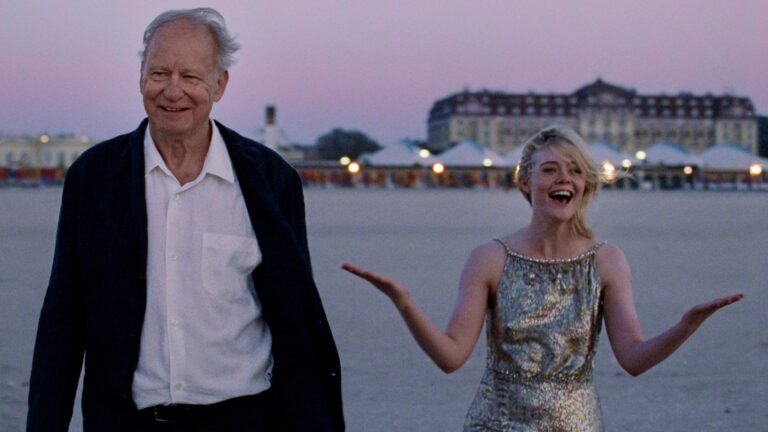

In Sentimental Value, filmmaker Joachim Trier explores family, ambition and artistic legacy through the story of sisters Nora and Agnes as they reconnect with their estranged father, Gustav (Stellan Skarsgård), a once-celebrated filmmaker attempting a late-career comeback. When Nora turns down a role in his new project, the part is given to Rachel Kemp (Elle Fanning), an ambitious Hollywood actress who finds herself inserted into a personal and emotionally fraught family dynamic.
Fanning, who earned Best Supporting Actress nominations from both the Critics’ Choice and Golden Globe Awards, spoke with Casting Networks about the art-imitating-life setup of the role playing a Hollywood actress arriving in Norway to work on a film led by a respected Scandinavian director. She also discussed how spending a lifetime in front of the cameras, years of auditioning, and more recently producing, have shaped her perspective on casting.
Key Insights
• Elle Fanning relates to her character Rachel as an actor who has hit a career low and must rediscover confidence and creative agency.
• Working with Joachim Trier allowed her to access deeper emotional truth through silence, stillness, and genuine connection with scene partners.
• Years of auditioning and producing have taught her that casting is about seeing potential in people, not just performances on a page.

On the surface, the similarities between you and Rachel are quite obvious, so let’s talk about the differences and how you relate to her.
The similarities for sure struck me, but at the same time, she’s a different kind of actor than I am. We find her in a place where I don’t feel like I am as an actor, but that I have felt in the past. I started acting when I was two, so the ebbs and flows of the industry [is something] I’ve felt for a long time.
You go through those ups and downs. We find Rachel at a down point. She’s lost. She doesn’t feel like she has a lot of power over her choices and her career. Gustav really ignites this spark in her again. Taking that leap of doing a film like that for the kind of actor she is, is very brave.
Rachel often feels like an outsider in Norway, as she’s prepping for her role. What about that outsider perspective resonated with you?
Rachel certainly feels like [an outsider], and that’s something that really drew me to her. This character could have been written as a Hollywood starlet cliché, but she ends up being this catalyst that mends this family because she has this outside perspective.
She has such emotional intelligence and walks away from the part, and away from this dream that she wants very badly. The layers of that, and the challenge of the meta-ness that was going on, all of those things were enticing to me.
Have you ever had to walk away from a project you wanted, even if the circumstances weren’t as extreme as Rachel’s?
I have never walked away that far down the line [in the production process] because she’s about to start filming. However, there certainly have been scripts and projects that I’ve read over the years that I felt I wasn’t right for and said no [to].
Early in your career, how much freedom did you have to choose roles, and how did that shape your development as an actor?
I started when I was two years old, so I wasn’t picking and choosing. Certainly, the things I went to audition for, I hoped that I got. When Sophia Coppola comes to you, and there’s a part for an 11-year-old girl in her movie, and you’re 11, you’re like, “I want to be that girl. I am going to try to get this.”
Also, when you’re that age, there’s only a handful of projects that have kids in them with great parts and great directors. You hope that you’re able to get it, because I didn’t go to acting school. I learned on the job because I got to work with incredible directors of that caliber.
How have you grown as an actor over the years in terms of craft, beyond just age and experience?
There are so many moments in my career that I can pinpoint the shift or the feeling that I’ve opened up more, learned more, and been able to express myself more. This year in particular, I did have that experience.
What was it about working with Joachim Trier that sparked that growth for you?
I think it’s because Joachim is able to capture something on set that is really unique. The environment that he creates is very singular and special. You never feel rushed. He lets you live in the silences of what’s unsaid. It’s not about the lines that are being said.
It’s everything in between. I was looking into Stellan’s eyes in these takes for minutes on end. What that does to you when you’re connecting genuinely with someone, the emotions that it brings out of you, is really special.
Looking back, what were some earlier projects that marked important turning points in your confidence or creative evolution?
I think there are a lot of stepping stones. I could probably give an argument for all of them. The Neon Demon, was one. The Great, a show I did for three seasons [on Hulu about Catherine the Great] was huge for me. I felt like I grew so much in being able to almost embarrass myself [with the] comedy.
I started that show when I was 20 years old and finished it when I was 25, so I was growing, and Catherine, who I played, was almost [my age] so she was informing me, and I was informing her. She was the most exciting character I’d played. The places that she got to go, it was endless and fun and wild. I feel like that experience set me up with confidence and with feeling powerful.
As someone who has spent years auditioning and now also works on the other side as a producer and executive producer, how has your perspective on casting directors evolved?
I’ve been lucky to work with casting directors since I was young, from auditioning and being in the room, and them reading with me. It’s a special gift they have to be able to spot potential in someone. Because how can you create the exact environment of how the scene is going to be when you’re reading in an office? It doesn’t emulate what a film set feels like. But that’s the gift of casting — they’re able to pick that potential out.
And now, as a producer myself, I did this show that’s coming out called Margot’s Got Money Troubles. Working with the casting director on that to create families, to create friends, to really put a group of people together that felt authentic … all the best directors, when you talk to them, they will all say that it starts with casting. Not just the leads — it’s everyone that helps build this environment, and tone of the film.
As an actor, you know how vulnerable auditions can feel. How does that empathy influence the way you approach casting as a producer?
I don’t like auditions. Auditions scare me, so I have a lot of empathy for actors, for sure. You can’t judge them on just that one audition. I think the best casting directors, for them, it’s not about the scenes; they get to know the person, which is important. Like, how are they going to work with this director in this environment? Are they kind, good people? Are they going to get along with everyone? So [as a producer] that’s kind of how I go about it.
Key Takeaways
• Feeling lost or powerless in your career is often the moment that leads to your next creative breakthrough.
• The best performances come from directors who create space for emotional honesty rather than rushing the process.
• Casting is about more than a single audition, so actors should focus on showing who they are, not just what they can perform.