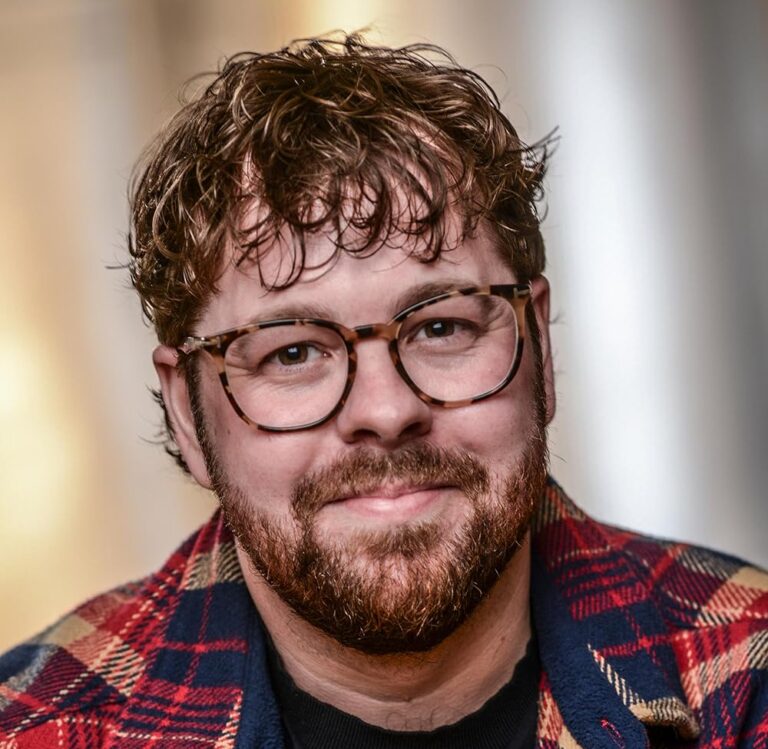

Thyrza Ging is like many casting directors: she did something else before she found her calling, but in the nearly two decades since that major decision, she has become one of Ireland’s most talented and sought-after professionals. Working alongside the legendary Louise Kiely, she has helped produce dozens of films and TV shows, including The Lobster, Kin, Sherlock & Daughter, The Tourist, Foundation, and Obituary. Her latest project is the Blumhouse horror film Soulm8te, which hits theaters January 9. She spoke to us from her home office in Dublin.
Key Insights
- Casting reveals new dimensions of a script as actors bring distinct interpretations that expand what’s possible on the page.
- Even the smallest roles play a vital part in building a believable world and strengthening the overall story.
- Careers in casting often evolve through persistence, timing, and mentorship rather than a straightforward path.

How did you get into casting in the first place?
When I was in school, a lot of the other people had an interest in acting or theater or music or performance. I had a love of film from my family. My father, in particular, introduced me to films at a very early age. He grew up in a cinema like the kid from Cinema Paradiso. His dad was the projectionist when he was alive, and his mum ran the tuck shop (concessions) and the ticket window. He remembers his dad going into town to collect the reels for the weekend’s shows, and has memories of sitting in the seats and shooting his cap guns at the westerns while his dad was running the reels ahead of the shows. Cool memories to have and definitely where my love of film comes from.
So when we left school, some of them became actors, and they started auditioning for this thing called a “casting director,” which I didn’t even know was a job at the time, but we would go to the theater in Dublin and we’d play the casting name game, and then I realized there was a job called the casting director, so I thought that’s really cool. In college, I was doing international commerce, so I kept going with that and got a job with a startup company. I worked there for a number of years, but just kept coming back to this, to be honest.
It kept calling out to you?
Yes, so I left, and I started knocking on doors. I was in the right place at the right time, as Maureen Hughes needed an assistant. She was working on a film, and she needed an assistant to set up appointments in schools for 16- and 17-year-old girls for the lead role in this film. So I would travel around the country, go into the schools and photograph them all, then we would go through them and call in the ones that she had picked from the photographs, see if they could act. It was a mad time.
I’ve talked to Maureen. She’s amazing. What did you learn from her?
Maureen’s deadly, isn’t she? (Laughs) She’s fantastic, and she’s so incredibly generous as well. She had sent me the script, and I had printed it out and bound it. I walked in, and she said to me, “Oh, my God, you’re really organized. Yes, you’re hired.” So had I not found that script? I may not be sitting here today, but she was incredibly generous, and she taught me so much. She helped me put the words on what I knew. She’d ask me, “What did you think of that actor?” And I’d say, “It doesn’t work, and I don’t know why it’s not working,” and then she would help me to describe why it wasn’t working and give me those words.
How did you connect with Louise Kiely?
I went out on my own, and then the recession hit, and I did two years as an agent. I was the worst agent out there. I couldn’t get my clients booked, but it was really interesting, and good to see everything from the other side of the table. Louise and I had been pals, and she needed somebody, and so I was coming to work with her for six weeks. That was 13 years ago in January.
So it’s been working out.
So far! (Laughs)
There’s a theme here. Casting and agenting, you’re working with actors. Is there something specific about working with actors that you find so appealing?
Oh, listen, working with actors I love. One thing I love about my job is that I send the same scene to X amount of actors, and what I get back, you know, 50% might be kind of similar, but then 20% it’s, “Wow, I didn’t see that as a way to play this scene.” And another 30% have done something slightly different. They’re different interpretations of what is effectively exactly the same words. Sometimes, with smaller parts, there’s less interpretation that you can put into it, but you can also bring your talent and your enthusiasm and your understanding, your imagination, because it is imagining, even though it’s a self tape. You have to imagine what’s actually happening, imagine the soldiers coming toward you, or the monsters coming to get you, or whatever it is, it has to feel real and truthful. So I love what they can bring. But it’s also wanting to look at every small part and elevate it and think, “How can we make this really cool? How can we add something to what might be a small role on the page? What can we do that’s going to bring the overall world to life?”
It’s all a puzzle. Every part is a puzzle, and you want to find the right piece to make the overall better than it is.
Yeah. And I’ve asked you to consider this small role for a very clear reason as well. Yeah, exactly. Because a lot of the time, there’s a huge, big reaction, there’s a moment, there’s a thing, but they only have one line. Yeah, they don’t like the one-line bit, but there’s a bigger part to the picture.
I think people lose sight of how important those one lines can be in a project.
It’s a very hard thing to tape for one line, but take a step back, stop and think, create the scene. What’s happening just before this line? What’s happening just after this line? Can you give me two more moments of this character? Actors are endlessly fascinating. I love watching tapes. I love each new project because the process is always the same. You start with a script, and you end up with a cast, and how you get from A to B, it’s pretty much the same with each project, but each project is different, and the people involved in each project are different. We just finished a television series for Fox, and we are casting a lot of European actors, and we’re watching these really gorgeous European actors who are maybe quite well known in their own countries, who we don’t know so well, delivering these fantastic comedy scenes in English, which is their second language. It’s amazing what actors can do.
Can we talk about Obituary?
Oh, do you like that show?
I absolutely love that show. I think Siobhán Cullen is such a brilliant match of actor to character. I know it’s a few years ago, but how did that happen?
We knew Siobhán. Elvira was written as early to mid-20s, so we went out to the Irish actors in that age group, and just watched. Again, it is that thing of being a casting director, you could have somebody in your mind, and then they read the scene, and they don’t get the character as somebody else could come in and be exactly what you say, “Oh, my God, mind blown.” They’ve tapped into that weirdness, or whatever it is character might have. That was Siobhán. It’s all about right place, right time, isn’t it?
That’s your whole career, right?
(Laughs) Exactly, it is. It really is.
You’ve got Soulm8tecoming out. And this is another movie that fascinates me. How do you go about casting an AI robot?
Lily Sullivan plays the main robot, and Isabelle Bonfrer is playing another. She had to be a particular height. She had to be a particular size because we were matching robots to a manufacturing requirement. So there was a baseline, and yes, we were looking for a slightly … mechanical performance, shall we say? For want of a better word? But we still needed it to live in the real world and feel truthful, but also feel slightly other. Too much was not right, but it was a matter of subtlety between the two. That’s the whole premise, right? The idea is that they’re otherworldly, so luminous, and have a slightly removed quality.
What piece of advice or wisdom would you give to an actor coming in to see you?
I would say relax. Remember, I’m on your side. Be prepared, and don’t sweat it. If you’re coming in to meet me for something, it means that I’m already on your side.
So many actors still don’t understand that, that it’s not an adversarial thing. It’s very much that you’re all working for the same goal.
Exactly, and I want to do everything in my power to put you at ease, because I also appreciate that it’s a very stressful moment for any actor coming in, so I will do my best to make sure that it’s a nice, warm room that you’re coming into, but you know, sometimes I think actors forget that. Sometimes nerves get the better [of you]. But if you know your scene, if you’ve done the work, you’ll be fine.
Key Takeaways
- Strong preparation helps actors manage nerves and deliver more confident, grounded auditions.
- Casting directors and actors share the same goal of serving the story, making the process collaborative rather than adversarial.
- Subtle, truthful performances create more compelling characters than exaggerated or overly mechanical choices.