
Suburban dissatisfaction has never looked quite so dangerous. HBO’s new limited series DTF St. Louis plunges into the loneliness and desperation simmering beneath seemingly happy middle-aged lives, and the catastrophic mistakes that can follow. In this case, it’s a love triangle between three adults, which ultimately leads to one of them ending up dead.
Key Insights
- DTF St. Louis uses a nonlinear, multi-perspective structure to deepen suspense and constantly shift audience assumptions about the central murder.
- The series explores middle-aged loneliness and dissatisfaction as catalysts for impulsive decisions that spiral into irreversible consequences.
- The emotional core of the show lies in the fragile, unexpected friendship between its two male leads, adding humanity to an otherwise dark narrative.

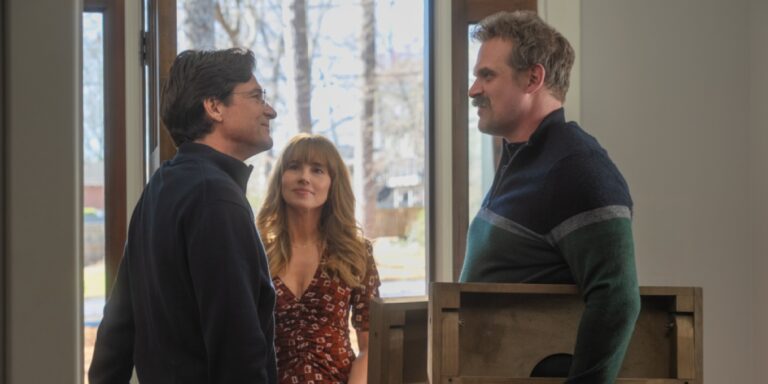
The story follows the budding friendship between local news reporter Clark (Jason Bateman) and Floyd (David Harbour, in his first TV role post-Stranger Things), an interpreter who works with the station’s ALS-accessible broadcasts. Both men feel trapped in unsatisfying marriages, so Floyd joins a hookup app at Clark’s suggestion. Meanwhile, Clark secretly begins an affair with Floyd’s wife, Carol (Linda Cardellini). When Floyd is found dead, the seven-episode series unfolds as a nonlinear investigation that gradually exposes the secrets and desperation driving each character’s choices.
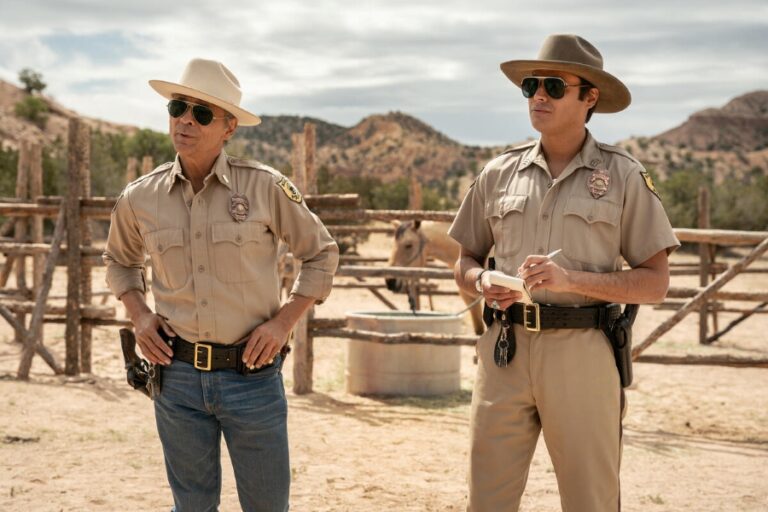
The show also stars Richard Jenkins and Joy Sunday as the investigators tasked with unraveling what happened.
At a press conference attended by Casting Networks, show creator Steve Conrad (Patriot, Perpetual Grace LTD) said he and Harbour wanted to create a show that would showcase the dissatisfaction and desperation that can happen in middle age. Eventually, they developed a concept centered on a set of middle-aged people in a suburban community over the course of one summer in 2018.
“David and I agreed to hang a series of suspenseful and tense events that might follow from grown-ups making mistakes, then trying to fix them, only to create greater mistakes,” Conrad said.
Bateman says the unusual storytelling structure immediately grabbed him when he read the scripts.
“I just remember racing through those scripts, and I just could not believe how unique and original almost every single page was without it ever sort of jumping a shark,” said Bateman, recalling his first reaction after Harbour reached out to him about the project.
Cardellini had a similar response. “I was so moved by it,” she said. “I had not read anything like it. It doesn’t move linearly.”
The nonlinear storytelling also required the actors to carefully track what each character knows and when.
“We had to keep in mind that the audience is gonna try to figure out who’s behind this death. And there are certain things in the plot that give certain characters motivation. There are certain emotional points. And so, it was important for us all to remember, ‘Okay, what does the audience know? What do they assume? Or, what does the character know and assume? And at what point and what stage?’” said Bateman.
Harbour says the layered narrative makes the show even more complex.
“There’s so many levels to it,” he said. “Because not only are we telling it out of order, but we’re telling it from different people’s perspectives, from investigations, from detectives, from simple memories, from different things.”
At the heart of the story is also the unlikely friendship between Clark and Floyd. For Harbour, that dynamic mirrored his own off-screen connection with Bateman.
“From early discussions with Jason, I felt camaraderie, and I started to let my guard down,” he admits. “It’s hard as a 50-year-old heterosexual male to make new friends. I’ve found it hard. And yet, even that process of making a new friend in him … I would let those colors play on me as we played the scene. I think the chemistry was very organic, and I’m very pleased to see that it translates on screen so well.”
Bateman agreed that rapport came easily. “In any occupation, it is a choice to have a connection with the people that you’re working with and building with. When you’ve got people that aren’t jerks, it’s not tough. And Steve … provided an environment where it was safe to explore all those things and cast a bunch of people and crewed it in such a way where that process was very simple.”
By his own admission, Bateman reveals the show pushes him into territory he’s not used to exploring on screen: sexual intimacy.
“I was definitely a little apprehensive about it all, but looking forward to the challenge. And Steve made me feel super comfortable early on when I had phone calls with him about what his expectations were regarding these scenes. Fortunately, my character is someone who’s not comfortable with it either!”
That awkwardness becomes part of the show’s tone.
“It’s so vulnerable and human and uncomfortable to watch these people experiment with becoming more dynamic in their lives,” observes Bateman. “It’s awkward and ugly and not sexy. This is not a titillating show; it’s equal parts tragic and humorous. That’s what compels you to just keep watching … because these people are so bravely diving off into the void.”
These contrasts are evident in Harbour’s Floyd as well. A physically big character, the audience gets glimmers of a past life where he was physically potent in a way he knows he’ll never get back to, which haunts him. Then, during one such encounter from the app, Clark does something surprising.
“Basically, he’s very gracious in a situation where normal people wouldn’t really be gracious,” observes Harbour. “Sometimes, as an actor, you’ll discover things in a script, and you’ll go, ‘That doesn’t feel like my character.’ Then, there are other times when you get curious and go, ‘Maybe I could build a character around this choice.’”
Those moments of surprise, he says, are part of what makes Conrad’s writing so compelling.
“I’m never settled as a viewer,” Harbour said. “That’s so pleasurable and so rare. It allowed us, as actors, to embrace the things that were weird about these people.”
For Cardellini, Linda’s emotional conflict is often reflected visually through her wardrobe. During her secret affair with Clark, the character sheds layers in motel rooms. But at home, she’s buried under the bulky uniform she wears as a little league umpire, a look her husband finds repulsive.
The uniform, she said, also reflects the burden Linda carries in her personal life. It’s her second marriage, and instead of being taken care of as she expected, she finds herself responsible for supporting the household, including her son, who refuses to accept Floyd as a parental figure.
“It’s a lot on her, and so the weight of that outfit is kind of like the weight that she carries in terms of trying to make extra money and making ends meet,” she said.
Key Takeaways
- HBO’s DTF St. Louis blends dark humor and tragedy to portray the messy, uncomfortable reality of people seeking change later in life.
- Strong performances from Jason Bateman, David Harbour and Linda Cardellini elevate a complex, character-driven mystery.
- The show’s unconventional storytelling and emotional vulnerability make it a standout among recent limited series.